Mon, 10 Oct 2005
Goodbye g.o.r.i.l.l.a...
I've taken the opportunity of a holiday space to rethink and refurbish
this Action Research inquiry into facilitating the power of love and
confronting the love of power.
To more clearly underline the aims and intentions of the inquiry, I've moved it to new location and put it into a new more accessible format. I've also
changed the title from g.o.r.i.l.l.a. to
livingfromlove.
This may also help me manage the incoming tide of powerfreakery that
here, as in the rest of life, tends to swamp the living from love.
To keep the earlier unfolding of the inquiry easily accessible, I've
created a separate
CONTENTS listing
the material as it emerged... from earliest to latest.
In honour of the antecedents of this phase of the inquiry, I'll quote a
few paragraphs from its opening statement
g.o.r.i.l.l.a.
began ten year ago as a focus for resisting the abuse of power in the
work I do, psychotherapy. That is still a necessary task but it has
been overshadowed by the need to confront the abuse of power on the
wider political stage. OK, perhaps this is nothing new but events of
the last 10 years have sharpened my perspective.
What do I see? Two key trends:
1. A more nurturing approach to
parenting—coupled with a greater tolerance and capacity for
emotionality. These seem to have led to an increasing awareness of the
extent to which sexual and child abuse, domestic violence and bullying
are a damaging facet of 'normality' in child-care.
2. The collapse of the USSR project and its client states, brought into
sharper focus the abuses of power by the US and its client states that
had previously been masked by the Cold War.
The first of these is close to home, part of the work I do. The second
has seemed out of reach, out of my range and competence but no longer.
The open assertion that 'full spectrum dominance' should shape US
foreign policy has made politics everybody's business. The notion that
links all these trends is Dominance—the belief that 'might is
right', that bullying is natural, that the use of force and coercion
are inevitable and essential ingredients of human life—and that
its shadow, subordination and victimization, is also natural and
inescapable.
g.o.r.i.l.l.a. is devoted to unravelling and confronting these beliefs.
They have seemed to be a 'given', a part of human existence. Might they
not be self-serving social constructions that promote and support
exploitation and generate damage? Might they not be obsolete? An old
paradigm of relating that promises to end all relating?
Some hints and pointers:
People who inherit, gravitate to, are elected to, or seize, dominant
roles, tell stories about reality that justify their tyrannies.
People who have been disinherited, side-lined, abused or exploited also
tell stories that often justify or rationalize their victimhood.
The extent to which the media mirrors through which we know ourselves
socially are in the hands of dominant corporate tyrants tends to mean
that victimhood is seen as due to failure and weakness.
Since tyrannies tend to have the power to enforce compliance, and
side-line or censor contradictions, their stories can seem to be
'true'.
A key element of how dominance plays out is dissociation. Tyrannies
hide from themselves the damage that arises out of dominance, or if it
cannot be hidden, it is held to be due to the weakness and failure on
the part of subordinates.
We can learn to recognize the cultures of domination that we inhabit
and resist, interrupt, and contradict them in ourselves and
others.
And where does love feature in all this? So far as love is defined as
the active mutual pursuit of flourishing with Others— it requires the
absence of coercion and force. In other words Dominance is
the antithesis of Love. Learning to love, learning to live from love,
thus requires that we also confront our inner tyrants, that we move to
eliminate our use of force and coercion and work to build the skills
and emotional competence that negotiation and cooperation require.
...
There are 0 writeback comments for this entry
posted at: 09:32 | permanent link to this entry
Wed, 10 Aug 2005
Goodbye g.o.r.i.l.l.a...
I've taken the opportunity of a holiday space to rethink and refurbish
this Action Research enquiry into facilitating the power of love and
confronting the love of power.
To more clearly underline the aims and intentions of the enquiry, I've
changed the title from g.o.r.i.l.l.a. to
livingfromlove.
This may also help me manage the incoming tide of powerfreakery that
here, as in the rest of life, tends to swamp the living from love.
To make the unfolding of the enquiry more easily accessible I've
created a separate
CONTENTS listing
the material as it emerged... from earliest to latest.
In honour of the antecedents of this phase of the enquiry, I'll quote a
few paragraphs from its opening statement
g.o.r.i.l.l.a.
began ten year ago as a focus for resisting the abuse of power in the
work I do, psychotherapy. That is still a necessary task but it has
been overshadowed by the need to confront the abuse of power on the
wider political stage. OK, perhaps this is nothing new but events of
the last 10 years have sharpened my perspective.
What do I see? Two key trends:
1. A more nurturing approach to
parenting—coupled with a greater tolerance and capacity for
emotionality. These seem to have led to an increasing awareness of the
extent to which sexual and child abuse, domestic violence and bullying
are a damaging facet of 'normality' in child-care.
2. The collapse of the USSR project and its client states, brought into
sharper focus the abuses of power by the US and its client states that
had previously been masked by the Cold War.
The first of these is close to home, part of the work I do. The second
has seemed out of reach, out of my range and competence but no longer.
The open assertion that 'full spectrum dominance' should shape US
foreign policy has made politics everybody's business. The notion that
links all these trends is Dominance—the belief that 'might is
right', that bullying is natural, that the use of force and coercion
are inevitable and essential ingredients of human life—and that
its shadow, subordination and victimization, is also natural and
inescapable.
g.o.r.i.l.l.a. is devoted to unravelling and confronting these beliefs.
They have seemed to be a 'given', a part of human existence. Might they
not be self-serving social constructions that promote and support
exploitation and generate damage? Might they not be obsolete? An old
paradigm of relating that promises to end all relating?
Some hints and pointers:
People who inherit, gravitate to, are elected to, or seize, dominant
roles, tell stories about reality that justify their tyrannies.
People who have been disinherited, side-lined, abused or exploited also
tell stories that often justify or rationalize their victimhood.
The extent to which the media mirrors through which we know ourselves
socially are in the hands of dominant corporate tyrants tends to mean
that victimhood is seen as due to failure and weakness.
Since tyrannies tend to have the power to enforce compliance, and
side-line or censor contradictions, their stories can seem to be
'true'.
A key element of how dominance plays out is dissociation. Tyrannies
hide from themselves the damage that arises out of dominance, or if it
cannot be hidden, it is held to be due to the weakness and failure on
the part of subordinates.
We can learn to recognize the cultures of domination that we inhabit
and resist, interrupt, and contradict them in ourselves and
others.
And where does love feature in all this? So far as love is defined as
the active mutual pursuit of flourishing with Others— it requires the
absence of coercion and force. In other words Dominance is
the antithesis of Love. Learning to love, learning to live from love,
thus requires that we also confront our inner tyrants, that we move to
eliminate our use of force and coercion and work to build the skills
and emotional competence that negotiation and cooperation require.
...
There are 0 writeback comments for this entry
posted at: 11:31 | permanent link to this entry
Mon, 01 Aug 2005
Reaping the whirlwind
- the London bombings
The London 7/7 bombings
and the 21/7 failure, lend impetus to this enquiry into the
naturalness or otherwise of
domination. I was touched by the number of people who called to check
that I was OK and surprised at the less than visceral shock
evoked in me by the
images and reporting of these close at hand events. Was this perhaps
because I had taken care to try to keep in touch with the parallel
atrocities in Iraq and occupied Palestine? Maybe... I certainly felt
that some
kind of blowback from the Iraq and Afghanistan attacks was
inevitable. Not a dissident view this, since police chiefs have been
talking
up the possibility of a UK attack for some months.
What surprised me more was that, in the media I see—excepting
Robin
Cook in the Guardian and Tony
Benn, BBC Newsnight—there was barely
a voice that asked the obvious question about 7/7, why would
anyone want to end their life in this way, as a suicide 'smart bomb'?
Was this a question that, out of undue respect for the victims and
their families was unaskable? Was the UK going to repeat the
denial of culpability that was prevalent in the US ?
Since a) I wasn't finding answers to this line of questioning and b)
prompted by
blatantly dominationist writing in a couple of the publications I have
access to, I started to look for myself.
On Tuesday July 26th Mark Steyn begins a piece in the
Daily
Telegraph:
According to his cousins back in Pakistan, Yorkshire lad Shehzad
Tanweer decided to become a "holy warrior" because of "US abuse of
Muslim prisoners in Guantanamo Bay".
There is, of course, no "US abuse of Muslim prisoners in
Guantanamo Bay". Newsweek's story about Korans being flushed down the
toilet turned out to be a crock; minor examples of possible disrespect
of the holy book are outweighed by multiple desecrations of their
Korans by the detainees. One man was exposed to Christina Aguilera CDs
played very loud in an attempt to break him, which I can't say I'd care
for. Another had large chunks of Harry Potter read to him, but don't
worry, it wasn't the new one.
None the less, to avenge the brutal torture of having Harry
Potter read to you by a woman, Shehzad Tanweer self-detonated on the
Underground and killed seven people. Ted Kennedy, Newsweek and the
British press might like to ponder that before they puff up the next
shameful torture technique (insufficient selection of entrées?)
into front page news.
Steyn ignores, or hasn't seen the Jane Mayer's article, New Yorker
July 11-18, which details the torture and ill treatment of Guantanamo
prisoners (and the role of psychological and medical professionals in
devising it). As she tells it, even FBI agents complained to their
superiors about Guantanamo interrogations:
"On a couple of occasions I entered an interview room to find a
detainee
chained hand and foot in a fetal position to the floor,with no chair,
food or water,' he wrote. Most times they had urinated or defecated on
themselves and had been left there for 18 to 24 hours or more." The
agent related that he had also visited an " almost unconscious"
prisoner in a room where the temperature was "probably well above 100
degrees, "There was a "pile of hair next to him." (He seemed to have
pulled out his own hair.)
How do you suppose, coupled with the Abu Ghraib images, Steyn's blatant
denial of the torture of prisoners in Guantanamo reads
to an adherent of
Islam in the UK or the rest of the world?
The Steyn article led me to another article, in the Spectator,
The myth of moderate Islam where
Patrick Sookhdeo pilloried a Pakistani writer Abid Ullah Jan for
having apparently applauded the
London bombings. 'The gist of the article', Sookhdeo claimed:
... is that Muslims should strive to gain political
and military power over non-Muslims, that warfare is obligatory for all
Muslims, and that the Islamic state, Islam and Sharia (Islamic law)
should be established throughout the world. All is supported with
quotations
from the Koran.
Sookhdeo
goes on to argue that:
...the Koran is like a
pick-and-mix selection. If you want peace, you can find peaceable
verses. If you want war, you can find bellicose
verses. You can find verses which permit only defensive jihad, or you
can find verses to justify offensive jihad.
Moving off Ullah Jan's text, Sookhdeo says that in the Qur'an:
You can even find texts which specifically command terrorism, the
classic one being Q8:59-60, which urges Muslims to prepare themselves to fight non-Muslims, ‘Against them make ready your strength to the utmost of your power, including steeds of war, to strike terror into (the hearts of) the enemies’ (A. Yusuf Ali’s translation). Pakistani Brigadier S.K. Malik’s book The Quranic Concept of War is widely used by the military of various Muslim countries. Malik explains Koranic teaching on strategy: ‘In war our main objective is the opponent’s heart or soul, our main weapon of offence against this objective is the strength of our own souls, and to launch such an attack, we have to keep terror away from our own hearts.... Terror struck into the hearts of the enemies is not only a means, it is the end itself. Once a condition of terror into the opponent’s heart is obtained, hardly anything is left to be achieved. It is the point where the means and the end meet and merge. Terror is not a means of imposing decision on the enemy; it is the decision we wish to impose on him.’(my emphasis)
Sookhdeo argues that the notion that 'Islam is peace' doesn't stand up
to close inspection of the Qur'an, an often quoted verse does say that
‘If you kill one soul it is as
if you have killed all mankind.’ but he goes on, the full
and unexpurgated version
of Q5:32 states:
‘If anyone slew a person —
unless it be for murder or
for spreading mischief in the land — it would be as if he slew the
whole people.’ The very next verse lists a selection of
savage punishments for those who fight the Muslims and create
‘mischief’ (or in some English translations ‘corruption’) in the land,
punishments which include execution, crucifixion or
amputation.
Hmm. All the Muslims I have met have been notably gentle, kind and
caring, so what is it that has got up the noses of those who see their
destiny as suicide bombers?
That something is up the nose and more, of Abbid Ullah Jan, is easily
apparent from even a casual dip into some of the writing helpfully
listed here.
Rage is what first comes to mind, the rage of a lightning conductor,
someone who is trying to channel the huge emotional charge of oppressed
subordination so that it reaches the ears of dominant ruling
classes. A tough role, Al Jazeera is another example, and one likely to
damage those who hold it.
In the first piece I came to,
The
"Death Cult" or Superfascism Ullah Jan answers my question of why
anyone would want to end their lives as a suicide bomber. It's nothing
to do with Islam.
What made the young Muslims,
raised in this society, do this?
...Bush, Blair and their fellow war lords have a pre-conceived answer
for this question: Muslims are “in the grip of a dangerous cult” of the
“poisonous misinterpretation of Islam.”
We are told: “No, Islam is a great religion. They act like
misinterpretation.”
...Is it that blowing themselves [up] irrationally, and killing women
and children and all innocent people for no reason at all is dear to
Allah and He will reward Muslim with
70 virgin in heaven after their successfully blowing themselves from
limb to limb?
Ullah Jan dismisses any suggestion that there is a message within
Islam, misinterpreted or
not, that requires this martyrdom. He goes on:
An impartial analysis reveals
that it is not some kind of inspiration due to
misinterpretation of Islam, but depression and desperation as
a result of the lies and double standards of those who
have
exploited freedom and democracy to the extent of
turning it into something
worse than a death cult. Cult leaders die with the rest
of cult
members. They don’t kill those who are not part of the
cult. But the
super-fascists of the our age live peacefully while
putting the future of humanity at
stake.
Unlike the cult phenomenon, the super-fascists prefer to live and rule the
world. For realizing their totalitarian designs, they don’t
mind lying, cheating and killing their own people at
home as well as through sending them abroad for
invasions and occupation. Killing
hundreds of thousands of aliens, who do not share their
religious faith,
culture totalitarian ideologies, is not even as much as
a pinprick for
their dead conscience.
Since Islam doesn’t approve killing of innocent civilians and no sane person
can ever leave all his own loved ones behind and go on a mission
to kill innocent loved ones of others, it must be
something far more serious than the myth that these
individuals are suffering from
“a poverty of dignity and wealth or rage.”
The perpetrators could be Muslims. But they are definitely not inspired
by religion or its misinterpretation. They are the
product of a
reaction to the super-fascism of their age.
And so I was returned to my theme of domination. Ullah Jan
distinguishes
in this article between jihad and jihadism:
Jihad is always for
self-actualisation, eradication of mischief and eliminating oppression
with a focus on spiritual aspect at all levels.
He sees jihad
ism as a label:
that the US uses as a bogyman to
criminalise resistance to its illegitimate occupations and to justify
the policy of total domination through its “war on terrorism.”
In support of this he points to evidence suggesting that the Russians
were seduced into invading Afghanistan by the CIA's promotion of jihad
and the information that the generation of jihadis that Bin Laden
orchestrates were nourished by vast amounts of US produced educational
material:
The Washington Post's Joe
Stephens and David B. Ottaway report
about this process
of spreading, what the US now
labels as “Jihadism”:
"In the twilight of the Cold War, the United States
spent millions of dollars to supply Afghan schoolchildren with
textbooks filled with violent images and militant Islamic teachings,
part of covert attempts to spur resistance to the Soviet occupation.
The "Primers", which were filled with talk of jihad and featured
drawings of guns, bullets, soldiers and mines, have served since then
as the Afghan school system's core curriculum. Even the Taliban used
the American-produced books..." [2]
Unlike the ongoing efforts to eliminate the Islamic concept of Jihad
from school curriculum around the Muslim world, Stephens and Ottaway
identify how the US governmental and educational organizations were
involved in actually developing Jihad-focused textbooks. They write:
"Published in the dominant Afghan languages of Dari and Pashtu, the
textbooks were developed in the early 1980s under an AID [Agency for International
Development] grant to the University of Nebraska-Omaha and its Center
for Afghanistan Studies. The agency spent $51 million on the
university's education programs in Afghanistan from 1984 to 1994."
Under this Jihadism project, the images and talk of resistance to
occupation were craftily intermingled with regular education: "Children
were taught to count with illustrations showing tanks, missiles and
land mines, agency officials said.
"One page from the texts of that period shows a resistance
fighter with a bandolier and a Kalashnikov slung from his shoulder. The
soldier's head is missing. Above the soldier is a verse from the Koran.
Below is a Pashtu tribute to the mujaheddin [sic], who are described as
obedient to Allah. Such men will sacrifice their wealth and life itself
to impose Islamic law on the government, the text says."
The United States’ Jihadism successfully transformed Afghan children
into true freedom fighters. None of the present analyst, obsessed with
using the word Jihadism and Jihadists, wrote a single word to condemn
the US ways to promoting violence. Many of the presently labeled
“Jihadists” live on from that period to join or morally support the resistance
against new occupations.
Now that the US comes to reap the whirlwind, many Americans
consider attacks on US occupation forces a shocking and
unsettling crime.
I begin to feel hooked by two narratives here. One story says that the
'terrorism' in London, Madrid, Bali, Sharm al Sheik and Israel is due
to
an insane distortion of Islam which seeks by these means to bring a
sharia law caliphate to the presently non-Muslim world.
The other story tells us that the extremity of self-immolation of
suicide bombers can only be accounted for as the coming to focus of a
reservoir of rage due to 80+ years of imperial and colonial oppression
of Muslim peoples by western governments through military force and the
privileged promotion of corporate
interests.
Following
C.S
Scott's highly recommendable notion of dominant and
subordinate political narratives that are often unable to hear each
other, let
alone empathize with the other story, this sounds promisingly like
such a pairing.
The dominant narrative can't/won't hear the subordinate narrative,
partly because it is perceived as coming from a 'barbaric', or
'primitive' culture but
mostly because to accept it all would fatally undermine the politics of
the dominant story. (if hostage takers empathize with their captives,
they
are much less likely to be able to kill them)
The subordinate narrative, with neither the assets nor the power to
negotiate with the narrators of the dominant story, tells its tale
through welding whatever
spiritual imperatives that are to hand to the indigenous ingenuity of
the suicide bomb.
Through doing this, the oppressed of the worldwide muslim communities,
finding a smart weapon that upstages the smart
weaponry of the
dominant, reproduce in the streets of Baghdad and
London and Bali and Madrid, the domination of the oppressor. Non
violent direct action doesn't (yet) seem an option.
Paradoxically, this matching of resources compromises the subordinate
storytellers' cause, since it enables a
curious perversion of blaming and media collusion in the re-telling of
the dominant story. Prime Minister Blair labels the
violence and damage of the London bomber's actions as 'evil', or
'criminal',
shutting down consideration of the oppressed muslim world's bombings
as a subordinate voice, with something to tell us that we need to
listen to. In
doing so he
endorses the US in its denial of culpability and joins the 'war
on terrorism', the transparent subtext of which is the licencing of
US 'full
spectrum dominance'
worldwide.
And so I get back to my beginning question, how come so few people seem
to ask why the London and other bombers would do something so extreme?
I'm inclined to
conclude that we don't ask this question because we inhabit cultures
of domination where the stories we are told, and that we are licenced
to tell ourselves, are sharply
restricted to those that don't unduly disturb the narrators of the
dominant story i.e. ourselves.
The answer we would find, as I seem to have found, is that for hundreds
of
thousands of people in the middle east
this, and
this, and
this,
and
this,
is the subordinate story they presently
inhabit. Such stories of pain, hurt, grief and suffering are hard to
bear, and if we can avoid them, we do.
After all, who except suicide bombers, would want to be a lightning
conductor carrying the
emotional charge of a 100 years of oppression, betrayal and
exploitation of the Middle East?
_____________________________________________________________
Abbid Ullah Jan is a regular contributor to
media-monitors
network-canada.
There are 0 writeback comments for this entry
posted at: 11:29 | permanent link to this entry
Sun, 31 Jul 2005
Pause for breath
Pursuing an enquiry like this is necessarily a haphazard matter. The
demands of employment and households knock me off my enquirer
perch. By the time I have climbed back up events have moved on,
agendas have disappeared and priorities have changed (note the bird in
a cage metaphor, an example of how despite our best efforts, domination
can live on in us !)
Also, the exploration and development of satygraha—positive
programme—tend to be overwhelmed by new items of evidence, new insights
into the how and why of domination.
And I begin to see an awkward tension between the unfolding of the
enquiry process and reporting on it. Too much detail of the process
(such as this piece) obscures its usefulness and yet the validity of
the enquiry requires being explicit about its process. I'm looking into
how to keep the process more distinct from the 'findings' or
reports.
Another example of the tail wagging the dog is that by far the most
visited area of g.o.r.i.l.l.a. is the Picture Gallery. This
pleases me a lot since one of the reasons I write and publish here on
the web is that it contradicts one of the hidden aspects of
domination—the hegemony of text (and some would say, English text)
OK, I could have published on these topics in refereed journals, but
academic publishing, though incomparably more accessible and
cross-indexed than it used to be, remains a vehicle for text and
diagrams.
And as I
found with my experience of
The Mind Gymnasium, writing and
developing an extensively illustrated book requires a quantum leap of
resources compared with monochrome text. In consequence a hierarchy of
importance is supported that unconsciously sells us the notion that
anything and everything of consequence can necessarily be
expressed in text and that images are of much less consequence.
This flies in the face of daily reality where tv and
cheap colour printing, and more recently, the Internet,
digital still and cameras, dvds, colour printers, camera phones,
photocopying etc, have made the image ubiquitous. Owning the means
of production for
publishing writing and images has become as commonplace as owning a
phone. (The challenge
to conventional politics that this poses has yet to work its way
through our electoral processes.)
Dominance weather
Like mobile phones the image is multilingual. And much of the surge of
political conflict of recent years seems to me to have been image fed.
For example if you are one of countless Muslims who live near this
advertisement in central Brussels, how do you handle its challenge to
your cultural preferences?
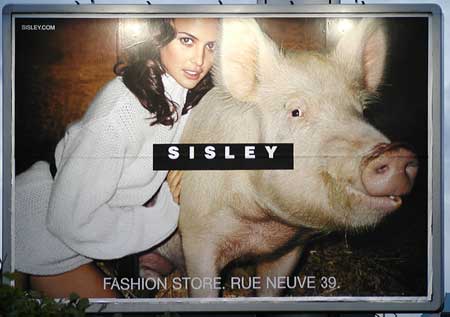
It speaks but what does it say?
That corporate capitalism, on the way to exhausting its exploitation of
the material world, is now busy colonising intimacy, sexuality...

...and human feeling, turning them into things, products?
'Oh well we all know this' you say. But is this colonization just a
trivial aspect of modern life, unworthy of the kind of
attention I give it here? Or does it, as I believe, amount to a kind
'dominance weather' that clouds the skies of daily life, hiding our
psychotic
devotion to the comfort zones of consumerism, religion and wealth
creation, and disconnecting us from feeling the damage that dominance
causes?
So
that when, as
James
C. Scott has pointed out, tension between this, and other,
opposing
ideologies become very heightened, and the lightning strikes of
'terrorism' kill those near and dear to us, we see it as god-denying,
ie
'evil', and 'enemy'-driven, not the result of the core beliefs about
human nature that we hold to be true.
The response to such lightning strikes by one London tabloid seem to me
a good examples of this 'dominance weather'.
In the face of the 9/11 attack on new York, the Daily Express
brandishes its crusader logo and its christian credentials.
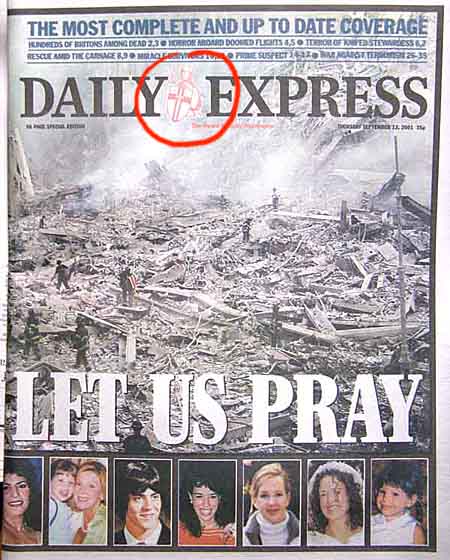
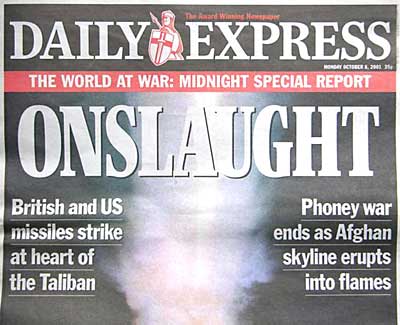
A month later, the worldview embodied in the Daily Express crusader
logo has been matched by the claim 'The world
at war'... (with Islam?)
In the week after the July 2005 bomb attacks on the London underground,
again under it crusader logo, the Daily Express claimed
(below) to know what the core values of its readers
demanded.

As I guess most of the world knows, the 'terrorist' the
headlines refer
to was a Brasilian electrician unconnected with the recent bombings
in the UK, who was killed by eight
bullets from armed
police while held face down on the floor of a London underground tube
train.
Newspapers
intentionally reflect and reiterate those attitudes that are proven to
sell
newspapers. This headline screams for the merciless vengeance of raw
dominance. Meanwhile the crusader (top) and the notion of 'evil'
(bottom) both
identify the page as brandishing a christian worldview. Do they
reflect, or create, or colonize, the worldview of the Express's 2
million readers?
If you haven't visited this enquiry's accumulation of other vernacular
evidence of how
deeply domination seems to be embedded in our daily lives,
take a deep
(preferably broadband) breath and visit the
Picture
Gallery now.
There are 0 writeback comments for this entry
posted at: 08:22 | permanent link to this entry
Sat, 30 Jul 2005
Giving children the education they deserve.
As the scale and depth to which domination and the love of power is
entrenched in our daily lives become visible
A question that arises real fast is how do we move from
the love of power to the power of love?
So far as we become aware of
this distortion of human potential in ourelves, we do what we can to
rectify it. And then comes another question, how do we help ensure that
our children or grandchildren don't be come affected (I was going to
say infected) by the cultures of dominance that we inhabit?
Conventional education, at least
in the UK too often seems to amount to 'schooling', regimes of
deference of one or
another kind in
which, in classes or 30 or more, the child is required to drink from
the fountain of a one
fits all state-defined curriculum. Many perhaps
most, seeing the 'jobs', 'career', 'qualifications', writing on the
wall shutdown creativity, imagination and self-direction, and get on
the hoop-jumping that is demanded. Not surprisingly, a substantial
vein of children decline this opportunity, embrace some form of
'Oppositional Defiant Disorder' and find better things to do with their
minds and energies, with corresponding benmefits and drawbacks
So if this is the prospect for
your child what do you do? One option a tough option is to found a
school that educates that how curioys that it needs to be said, is
child-centred rather than adults centered as state and private
education too often is.
In response to these kinds of
concerns, a colleague, Richard House, inspired the founding of a
Waldord Steiner School in Norwich, Norfolk, UK. I asked him to tell me
how he did it
Well, that’s a big question, with many
facets.
I have had 7 or so years
experience of the
Steiner schools movement now, since undertaking my first, Steiner Class
Teacher
training in the late 1990s. As well as being involved in the founding
of a
new Steiner school here in Norwich over the same time period, I am
a trustee of a major and long-established Steiner teacher training
course and a
regularly published writer on educational issues.
The decision to found a
school in Norwich was very much a collective decision taken by a
diverse group
of people (of which I was a part) who
both had major reservations about the nature of mainstream education
and
schooling systems, and also greatly admired the holistic educational
experience
that Steiner (Waldorf) education offers. I could say a great deal about
both of
these motivations, as I personally identify strongly with both of these
influences.
There is currently very little
if any
choice for parents and families who are dissatisfied with ‘mainstream
education’ (in which category I include both state schools and
independent schools which broadly follow the national
curriculum, and which mimic the testing and assessment regime of the
state
sector). Of course, families can opt for home education – and indeed
record
numbers are doing so; but for those parents who are either not inclined
to
home-educate, or for whom it would be quite impractical, Steiner
schools,
Montessori schools (which only commonly go up to about 8 years of age)
and
schools in the ‘human scale education’ (HSE) movement are just about
all that
is on offer in the UK.
Geographically, 7 years ago
there were just
two other Steiner schools in the whole of East Anglia – a small one in
rural
Norfolk and a larger one in Cambridge. I know a number of families who
have
actually changed careers and life-styles in order to relocate their
family so
that they live near a Steiner school – there must be literally hundreds
if not
thousands of families who have done this over the years. Norwich is a
very
independently minded part of the country, with lots of radical thinking
people
– the kind of medium-sized city that is a potentially ideal location
for a
Steiner school.
The original founding group
consisted of
three parents of young children who wanted a Steiner Kindergarten and
school
for their children, and an elderly anthroposophist who has been a
student of
Rudolf Steiner’s manifold cultural contributions for many years.
(‘Anthroposophy’ refers to the spiritual stream founded by Rudolf
Steiner after
the First World War, a movement which draws upon Steiner’s many
‘spiritual
scientific’ insights into humanity, life and the cosmos.)
As I understand it,
this is fairly typical of the way in which Steiner schools first begin:
although there is a lot of support available for new initiatives from
the
Steiner Waldorf Schools Fellowship, new schools necessarily emerge from
the
independent initiative of local groups who see a vision for a new
school in
their area and/or for their children, and set about bringing it about.
But
needless to say – founding a new school which is independent of the
state
system, and which has to be entirely self-financing through the efforts
of
people who are commonly not materialistic people with lots of spare
wealth at
their disposal, is far far more easily said than done! But I guess your
next
question will perhaps take us more into the actual process of founding
our school
– though of course (and as Steiner himself always emphasised), schools
are
always and necessarily unique.
But first, a bit about Rudolf
Steiner
himself and the educational system he spawned, as a kind of mystique
often
surrounds the man, which it is best to demystify at the outset. Not
least, it’s
a mystery to many just how one of humanity’s most original and
wide-ranging
thinkers and seers is so comparatively little recognised in the range
of fields
on which he has had, and continues to have, such a profound influence.
The
author of over 30 books and the deliverer of over 6,000 lectures in his
lifetime, his full collected works (in German) come to a staggering 350
volumes; and his lasting legacy includes uniquely innovative ‘impulses’
in
fields as wide-ranging as curative education and social therapy (the
world-renowned Camphill Communities); biodynamic agriculture (a
precursor of
organic agriculture); holistic (anthroposophical) medicine;
architecture and
design; the arts (Eurythmy, painting, speech and drama); organisational
consultancy; ethical banking and finance – and, of course, education.
Steiner held passionately to a
consistently
holistic, non-mechanistic approach to
human experience; and it is only now, when so-called ‘new paradigm’
cosmologies
are beginning to undermine the Zeitgeist
of a materialistic modernity, that Steiner’s remarkable insights are
beginning
to attract the widespread attention they richly deserve.
Some eighty years after the
first ‘Waldorf’
school was founded with Steiner’s blessing in Stuttgart (in 1919),
Steiner
Waldorf is now the world’s largest and most rapidly growing independent
schooling movement, with well over 800 schools and 1,500 Kindergartens
worldwide. So flexible and adaptable has the Waldorf educational
approach
proved to be in different cultural conditions that it is represented in
countries and continents the world over. Steiner’s educational
philosophy is developmentally informed, with the
teacher’s task being to provide the appropriate learning environment
consistent
with the needs of the unfolding child. This in turn requires, on the
teacher’s
part, a profound understanding of the subtleties of the developing
child; and
much of Steiner’s educational and other writings are taken up with a
detailed
articulation of such an understanding.
There is a lack of competitive
testing and
examinations in Waldorf education, with co-operation and ‘community’
being far
more valued than the individualistic competitiveness that inevitably
creates
winners and losers. The recently articulated
notions of ‘emotional intelligence’ (Dan Goleman) and ‘spiritual
intelligence’ (Dinah Zohar) were quite explicitly prefigured by Steiner
in his
educational philosophy, critical as he was of the one-sided
intellectualism
which he saw as giving a severely limited understanding of the world.
Steiner also saw education as
very much a
living creative art rather than as a
programmatic science, with human
relationship being an absolutely central aspect of any educational
experience. In Steiner education, what we might call the being-qualities
of the teacher are seen as being far more important
than the amount of purely factual information that the teacher knows;
and it
follows that the teacher’s own personal
development is seen as being a quite crucial aspect of being a
successful
Waldorf teacher. For Steiner, education at its best is also seen as
being an
intrinsically healing force for the
child – and sometimes for the teacher too.
Organisationally, the Waldorf
school has a
‘flat’, non-hierarchical structure, with no headmaster/mistress, and
with a
College of Teachers which works consensually to decide matters of
school
policy, administration etc. In Steiner’s time this was a quite
unheard-of
social innovation; and it is only in recent years that the emergence of
similar, non-hierarchical forms is beginning to make itself felt within
‘new
paradigm’ organisational arrangements. Freedom
is, therefore, a central aspect of the education – not least, freedom
from the
quasi-authoritarian ideology that, almost unnoticed, dominates so much
conventional schooling. Finally, Steiner was a fierce defender of the
right to
a childhood unburdened by imposed and misguided adult-centric agendas.
The extraordinary neglect of
his vast
corpus probably has at least something to do with Steiner’s
thorough-goingly holistic, non-mechanistic approach to
human experience, which, early in the last century, was quite literally
decades
ahead of its time; and it is only now, when so-called ‘new paradigm’,
postmodern epistemologies and cosmologies are thankfully beginning to
undermine
the Zeitgeist of modernity, that
Steiner’s remarkable insights, which both incorporate yet also
transcend
modernity, are beginning to attract the rich attention they deserve. To
give
just one example, over a century ago Steiner was the leading
international
scholar of Goethe’s much-neglected scientific works – and yet it is
only in
recent years (cf. Henri Bortoft’s The
Wholeness of Nature, Floris 1996) that Goethe’s scientific
worldview is
beginning to gain widespread recognition within the emerging paradigm
of ‘New
Science’.
Steiner was a relentless
scourge of the
one-sided materialism that prevailed in his day, and he brought a
spiritually
informed perspective to his educational worldview, which viewed the
human being
as far more than a material body. His educational philosophy is developmentally informed, with the
teacher’s task being to provide the appropriate learning environment
consistent
with the needs of the unfolding child. This in turn requires, on the
teacher’s
part, a profound understanding of the subtleties of the developing
child; and
much of Steiner’s educational and other writings are taken up with a
detailed
articulation of such an understanding.
Between birth and seven, for
example,
the child learns predominantly through imitation, repetition,
rhythmical
activity and free, unhindered play; and its main task is the
(unconscious)
development of the will in a milieu of reverence. In this schema,
formal,
intellectual learning is strictly avoided until the change of teeth
(between
six and seven), and Steiner stressed how the introduction of formal,
abstract
learning (e.g. reading and writing) before this age was positively
harmful to
the child – a finding which is at last beginning to be confirmed by
recent
child-developmental research. (This is indeed a common experience –
that modern
scientific research announces allegedly newly discovered knowledge
about human
development, yet which on closer examination, Steiner had himself
systematically articulated in the early decades of the last century.)
There is a lack of competitive
testing and
examinations in Waldorf education; and the intrinsically holistic
approach in
Waldorf education means that teaching is always done from
the whole to the part,
and not the other way around – thereby providing an antidote to the
mechanistic
reductionism of the modernist worldview. Moreover, the recently
articulated,
holistic notions of ‘emotional intelligence’ (Goleman) and ‘spiritual
intelligence’ (Zohar) were quite explicitly prefigured by Steiner in
his
educational philosophy, critical as he was of the one-sided
intellectualism which
he saw as being only capable of giving a severely limited understanding
of the
world.
The ‘death of childhood’ is a
theme that is
increasingly echoing throughout modern culture, and Steiner was a
fierce
defender of the right to a childhood unburdened by imposed and
misguided
adult-centric agendas. Overall, Steiner’s educational philosophy and
Waldorf
praxis together provide an impressively coherent and comprehensive ‘new
paradigm’ antidote to the worst excesses of a materialistic worldview
that has
brought our world to the foothills of ecological disaster and
unsustainability;
and in this sense it is supremely relevant as we struggle through the
death
throes of modernity and towards a new post-materialistic worldview.
Here are just a few quotations
from Steiner
on education which give a flavour of his philosophy:
·
If…
mechanical thinking is carried into education,… there is no longer any
natural
gift for approaching the child himself. We experiment with the child
because we
can no longer approach his heart and soul.
·
If…
the teacher continues to overload [the child’s] mind, he will induce
certain
symptoms of anxiety. And if… he still continues to cram the child with
knowledge in the usual way, disturbances in the child’s growing forces
will manifest
themselves. For this reason the teacher should have no hard and fast
didactic
system.
·
For
real life, love is the greatest power of knowledge. And without this
love it is
utterly impossible to attain to a knowledge of man which could form the
basis
of a true art of education.
·
You
cannot teach a child to be good merely by explanation… What you
actually are… is the most
essential
thing of all for the child.
·
Illnesses
that appear in later life are often only the result of educational
errors made
in the very earliest years of childhood. This is why… education… must
study the
human being as a whole from birth until death.
·
In
a state school, everything is strictly defined… everything is planned
with
exactitude. With us everything depends on the free individuality of
each single
teacher… Classes are entrusted entirely to the individuality of the
class
teacher;… what we seek to achieve must be achieved in the most varied
ways. It
is never a question of external regulations.
·
The
important thing is that we do not rob teachers of their strengths of
personality by forcing them to work within the confines of government
regulations.
·
It
is inappropriate to work towards standardising human souls through
future
educational methods or school organisation.
·
Our
education… only lives when it is carried out. It cannot truly be
described, it
must be experienced.
·
Receive
the children with reverence; educate them with love; relinquish them in
freedom.
It will be pretty clear from
the above
discussion just what kind of motivations underpin our disillusionment
with
modern mainstream schooling systems and our desire to create something
better
for our children. Where to start?!…
The devastation that has
recently been
wrought in Britain’s Early Childhood sector is symptomatic of the
pernicious
cultural forces that currently hold such uncritical sway in modern
culture.
Thus, modernist culture’s ‘managerial’ ethos of over-active,
prematurely
intellectual intrusion into the very
being of young children is part of a formal-schooling ideology
which, since
the mid-1990s, has been colonizing England’s early years policy-making
and
practice - with the relentless bureaucratization of early learning
environments
stemming from, for example, mechanistic developmental assessments,
centrally
dictated ‘Early Learning Goals’, and the imposition of a ‘curriculum’
on to
children as young as 3. These trends are, moreover, widely observable
in the
educational systems of Western world. In England, for example, we read
in the Times Educational Supplement of 17th
January 2003 that reception teachers are now having to work their way
through
no less than 3,510 boxes to tick, as
they are forced to assess every child against a staggering 117
criteria. This story broke again last summer, when in the Daily Telegraph of the 21st
June 2004, we read of teachers having ‘to write reports the size of
novels’
alongside test scores for five-year-olds. David Hart, the general
secretary of
the National Association of Head Teachers, was quoted as saying that ‘I
cannot
think of another Government intervention which has caused so much anger
among
teachers of the early year’.
With OFSTED (the UK’s Office
for Standards in Education) taking over responsibility
for early-childhood settings, we are witnessing a ‘surveillance
culture’
ideology cascading down the education system, right to the earliest of
ages.
Not without reason did the prominent sociologist, Professor Nikolas
Rose, write
some years ago that ‘Childhood is the most intensively governed sector
of
personal existence’. A whole range of factors continues to reinforce
the
one-sidedly cognitive ‘hot-housing’ atmosphere pervading modern
mainstream
education.
There is
little if any empirical research being carried out on the medium- and
long-term
effects on children’s overall social and emotional development of the
soullessly mechanistic educational ‘regimes’ and one-sidedly
materialistic
values and practices to which young children are being unremittingly
subjected.
This is nothing short of a national scandal, at which future, more
enlightened
generations will surely look back aghast at our wilful neglect of what
really
matters in living a healthy life. Yet in the face of the mounting
malaise and
anomie experienced by young people in modern culture, the mechanistic,
‘modernizing’
juggernaut simply ploughs on, apparently quite impervious to the
insight that its own policies and practices are
substantially contributing to this cultural chaos, and are storing up
an
anti-social disaster whose dimensions and ubiquity can scarcely be
dreamt of.
One common effect of these
disturbing
trends is what can be called the
dismembering of childhood (cf. Neil Postman’s seminal 1990s text The Death of Childhood). Certainly,
there is a growing ‘counter-cultural’ public mood which is clamouring
for a
humane and demonstrably effective alternative to the deeply
unsatisfactory fare
currently on offer in ‘mainstream society’ – and Steiner education is
just one
of the many humane cultural initiatives which are increasingly
challenging the
one-sided materialism of the modern age. Certainly, there are new
Steiner
education initiatives springing up all over the UK at the moment, so
what we
are doing here in Norwich, while of course unique, is just a part of a
far
wider cultural impulse.
There are 0 writeback comments for this entry
posted at: 18:56 | permanent link to this entry
Giving children the education they deserve.
As the scale and depth to which domination and the love of power is
entrenched in our daily lives become visible, a question that arises
real fast is, how do we move from the love of power to the power of
love?
So far as we become aware of this distortion of human potential in
ourselves, we do what we can to rectify it. And then comes another
question: how do we help ensure that our children or grandchildren
don't become affected (I was going to say infected) by the cultures of
dominance that we inhabit?
Conventional education, at least in the UK, too often seems to amount
to 'schooling', regimes of deference of one or another kind in which,
in classes of 30 or more, the child is required to drink from the
fountain of a 'one fits all' state-defined curriculum. Many,
perhaps most, seeing the 'jobs', 'career', 'qualifications',
writing-on-the-wall shut down creativity, imagination and
self-direction, and get on with the hoop-jumping that is demanded. Not
surprisingly, a substantial vein of children decline this opportunity,
embrace some form of 'Oppositional Defiant Disorder' and find
better things to do with their minds and energies, with corresponding
benefits and drawbacks
So if this is indeed the prospect for your child, what do you do? One
option - a tough option - is to found a school which - and how curious
that it even needs to be said - educates in a child-centred rather than
adult-centred way, as state and private education too often is.
In response to these kinds of concerns, a colleague, Richard House, was
instrumental in the founding of a Steiner (Waldorf) school in Norwich,
Norfolk, UK. I asked him to tell me how he did it. He replied:
Well, that's a big question, with many facets.
I have had seven or so years' experience of the Steiner schools
movement now, since undertaking my first, Steiner Class Teacher
training in the late 1990s. As well as being involved in the founding
of a new Steiner school here in Norwich over the same time period, I am
a trustee of a major and long-established Steiner teacher training
course and a regularly published writer on educational issues.
The decision to found a school in Norwich was very much a
collective decision taken by a diverse group of people (of which I was
a part) who both had major reservations about the nature of mainstream
education and schooling systems, and also greatly admired the holistic
educational experience that Steiner (Waldorf) education offers. I could
say a great deal about each of these motivations, as I personally
identify strongly with both of them.
There is currently very little if any choice for parents and families
who are dissatisfied with 'mainstream education' (in which category I
include both state schools and independent schools which broadly follow
the national curriculum, and which mimic the testing and assessment
regime of the state sector). Of course, families can opt for home
education - and indeed record numbers are doing so; but for those
parents who are either not inclined to home-educate, or for whom it
would be quite impractical, Steiner schools, Montessori schools (which
only commonly go up to about 8 years of age) and schools in the 'human
scale education' (HSE) movement are just about all that is on offer in
the UK.
Geographically, seven years ago there were just two other Steiner
schools in the whole of East Anglia - a small one in rural Norfolk and
a larger one in Cambridge. I know a number of families who have
actually changed careers and life-styles in order to relocate their
family so that they live near a Steiner school - there must be
literally hundreds of families who have done this over the years.
Norwich is a very independently minded part of the country, with lots
of radical thinking people - the kind of medium-sized city that is a
potentially ideal location for a Steiner school. (Note, however, that
across the globe there are numerous examples of Steiner schools which
are thriving in what are environmentally very unfavourable
circumstances - not least, in sparsely populated rural areas. And
despite a great amount of research having been conducted into what
makes for a successful school, there still remains something of a
mystery as to why some schools thrive in inhospitable circumstances
while others struggle in what appears to be an ideal milieu. Perhaps
the deep spiritual impulse that underpins these very special schools
has something to do with this phenomenon.)
The original founding group of the Norwich school consisted of three
parents of young children who wanted a Steiner Kindergarten and school
for their children, and an elderly anthroposophist who has been a
student of Rudolf Steiner's manifold cultural contributions for many
years. ('Anthroposophy' refers to the spiritual stream founded by
Rudolf Steiner after the First World War, a movement which draws upon
Steiner's many 'spiritual scientific' insights into humanity, life and
the cosmos.)
As I understand it, this is fairly typical of the way in which Steiner
schools first begin. And although there is a lot of support available
for new initiatives from the Steiner Waldorf Schools Fellowship (based
in Forest Row, East Sussex), new schools necessarily emerge from
the independent initiative of local groups who see a vision for a new
school in their area and/or for their children, and set about bringing
it about. But needless to say - founding a new school which is
independent of the state system, and which has to be entirely
self-financing through the efforts of people who are commonly not
materialistically oriented people with lots of spare wealth and
resources at their disposal, is far far more easily said than done! But
I guess your next question will perhaps take us more into the actual
process of founding our school - though of course (and as Steiner
himself always emphasised), schools are always and necessarily unique.
It will be useful to say something about Rudolf Steiner and his
wide-ranging work and influence, against the cultural backdrop of a
Western education system which is in abject crisis. But before this, I
will set out ten summary 'recipe-points' for all those considering
starting their own school:
(1) Find
friends and like-minded people in your local area who share a
common desire for a different, holistically-informed educational
approach for your children, and start to meet regularly (there will
almost certainly be fitting places in your local community where you
can advertise such a founding group; see also # 8, below).
(2) Starting up a study group
is very worthwhile - and a great place to start is to study Rudolf
Steiner's excellent and accessible lecture series THE KINGDOM OF CHILDHOOD. It is
also useful from the outset to read together some of the
anthroposophical literature on community building, as you will
inevitably encounter ordinary human difficulties and challenges in the
course of building your initiative. In this sense, participating in
building a school is very much a personal-developmental path for
everyone involved. You could try starting with Frieddrich Glasl (1994) The Enterprise of the Future;
Robert Rehm (1999) People in Charge; or Christopher Schaefer and
Tyno Voors (1999) Vision in Action:
Working with Soul & Spirit in Small Organizations (all
published by Hawthorn Press, Stroud, UK). And most recently, there is
Margaret van den Brink's excellent new book, Transforming Organisations (2004).
(3) Inform yourselves about
Steiner education through reading some of the vast literature that is
available, and above all by visiting
real schools, for it is only though direct experience, and by
observing the qualities of Steiner-educated children, that one can
really fully appreciate the wonders of this education. Many Steiner
schools or Steiner teachers training centres also regularly offer
lectures, conferences, workshops and short courses about Steiner's
various cultural innovations, including education.
(4) Register with the Steiner
Waldorf Schools Fellowship (in the UK; or the appropriate/equivalent
national organisation in your own country) to enlist their support for
your nascent educational initiative. In particular, inquire about and
seek help with the structure and consensual working process of a
Steiner school. These are very important questions to begin considering
from the outset, lest you construct organisational structures which
unhelpfully work against the founding of a successful school and then
prove to be very hard to 'restructure' once they have become
entrenched. Part of this process will be to set up a charitable company
or organisation, and your national Steiner education umbrella body will
be able to help with this.
(5) Related to the last point, actively and awarely cultivate a willingness to share power,
empower each other, and to challenge unhealthy concentrations of power
and responsibility in your nascent organisation. Any new organisation
is open and vulnerable to becoming the ground upon which people can
'act out' their desire for power, control etc. Very subtle balances
need to be struck here - not least, that of how to create an
organisation which everyone involved will experience as empowering, yet
without stifling the healthy initiative of those who have more energy,
time and, even, ability to contribute to the organisation than others.
In order to bring this about successfully, clear accountability
structures and a deep understanding of the consensual decision-making
process are pretty much indispensable prerequisites. Very clear
descriptions of the various committees and their respective
responsibilities will help all persons wanting to be actively involved
in the school to perceive where their personal and specific strengths
could best serve the growing school.
(6) Start a Parent & Child group
in as beautiful and peaceful a setting as you can find. The beauty of
these groups, certainly in the UK, is that they are still unregulated
by the state, so you needn't worry about being instructed to impose an
absurd 'curriculum' encompassing early literacy and numeracy on the
young children! Dot Male's soon-to-be-published PARENT AND CHILD HANDBOOK (Hawthorn
Press, 2006) is a veritable goldmine for anyone wishing to start a
Parent & Child group along Steiner-informed principles. Start as
you mean to go on in terms of financing, making sure that you charge a
fee that at least covers your expenses, plus a bit extra to start
building up a working surplus for the initiative.
(7) Make enquiries locally about whether there are any Steiner-trained teachers in the local area
or region who might support your initiative, or even become
directly involved. If you are very lucky, you may find a teacher
locally who can be instrumental in helping you set up a Kindergarten or
even the first class of a school. In addition, find one or more locals
who wish to train as Steiner teachers, starting with Kindergarten or
Parent & Child trainings, and start the training! (there are both
full- and part-time trainings available in the UK, for instance).
Within a few years, you will then have trained and qualified Steiner
teachers locally who can take the school-founding process forwards.
More generally, trained and experienced Steiner teachers are regarded
as the authorities on Steiner education, and their input into a newly
developing initiative is crucial if not indispensable in order that the
new initiative is properly founded in Steiner's educational approach.
(8) Publicity: early on in
your initiative, it is important to research local publicity
possibilities, and use them as much as possible to 'spread the word'
about what you are offering and planning for the future. You will be
amazed at the number of like-minded people out there just waiting to
find out about you! Above all, you can be very creative with publicity
- a small publicity group of people with imagination and the capacity
to 'think outside of the box' is a great asset. Be aware that very
large numbers of parents want 'something else' for their children,
based on their intuition alone, and they just need to find the school
that meets their concerns and aspirations - your school. This is indeed
commonly the way in which families come to Steiner education. Publicity
is always a combination of genuine enthusiasm and clear information.
Many recent studies in the fields of psychology, education and
neuroscience are corroborating what Steiner said more than 75 years
ago, and it works very effectively to utilize such 'modern knowledge'
to market the school and Waldorf education.
(9) Fund-raising: before too
long, if you follow the route of creating an autonomous school, the
issue of fund-raising will come up, as it is unrealistic the think that
parents alone can support all the costs related to the functioning of
the school. In Norwich, and in common with the experience of other
Steiner schools, we have found that trying to raise funds from
charitable bodies is very difficult, as we don't routinely cater for
disadvantaged or deprived children. However, you may well find a
wealthy local benefactor or notary who really believes in the education
and is prepared to support you financially in the early stages. Other
established Steiner schools have both traditional and more novel,
idiosyncratic ways of raising funds, and it will be important both to
inform yourselves of what has worked in other schools, as well as
coming up with your own ideas that are unique to your particular
circumstances.
(10) Finally, and above all, the virtue of perseverance is essential. There has
never been any school (or human organisation, come to that!), including
all Steiner schools, which do not from time to time experience
challenges and set-backs, and even crises. The issue here is not
somehow to expect your school to be a perfectly utopian conflict-free
school, but rather, that you are open to facing and meeting the
challenges that will inevitably arise with maturity, and see them as
opportunities for individual and collective development. The book The Enterprise of the Future (see #
2, above) could be very useful in helping you to understand the
'normal' evolution of an organization, in turn helping you
pre-emptively to avoid such 'developmental crises'.
If you succeed in achieving some or most of these 'founding
principles', it is very likely that before too long, you will have set
up an organisation and a community of parents that will generate its
own self-sustaining momentum - not least, because there is so
much general disquiet with mainstream education that you will draw to
yourselves a great deal of interest, once the quality of what you are
offering is recognised in the local area.
More, now, about Rudolf Steiner himself and the educational system he
spawned, as a kind of mystique often surrounds the man, which it is
best to demystify at the outset. Not least, it's a mystery to many just
how one of humanity's most original and wide-ranging thinkers and seers
is so comparatively little recognised in the range of fields on which
he has had, and continues to have, such a profound influence. The
author of over 30 books and the deliverer of over 6,000 lectures in his
lifetime, his full collected works (in German) come to a
staggering 350 volumes; and his lasting legacy includes uniquely
innovative 'impulses' in fields as wide-ranging as curative education
and social therapy (the world-renowned Camphill Communities movement);
biodynamic agriculture (a precursor of organic agriculture, and to
which Prince Charles is the latest high-profile convert!); holistic
(anthroposophical) medicine; architecture and design; the arts
(Eurythmy, painting, speech and drama); organisational consultancy;
ethical banking and finance (the Triodos Bank) - and, of course,
education.
Steiner held passionately to a consistently holistic,
non-mechanistic approach to human experience; and it is only now, when
so-called 'new paradigm' cosmologies are beginning to undermine the
Zeitgeist of a one-sidedly
materialistic 'modernity', that Steiner's remarkable insights are
beginning to attract the widespread attention across the world that
they richly deserve. Not least, this is because modern scientific
research is consistently yielding results which amply corroborate the
indications laid down by Steiner in a whole range of fields nearly a
century ago.
Some 80 years after the first 'Waldorf' school was founded with
Steiner's blessing in Stuttgart (in 1919), Steiner Waldorf is now the
world's largest and most rapidly growing independent schooling
movement, with approaching 1,000 schools and 1,500 Kindergartens
worldwide. So flexible and adaptable has the Waldorf educational
approach proved to be in different cultural conditions that it is
represented in countries and continents the world over. Steiner's
educational philosophy is developmentally informed, with the teacher's
task being to provide the appropriate learning environment consistent
with the needs of the unfolding child. This in turn requires, on the
teacher's part, a profound understanding of the subtleties of the
developing child; and much of Steiner's educational and other writings
are taken up with a detailed articulation of such an understanding.
There is a lack of competitive testing and examinations in Steiner
(Waldorf) education, with co-operation and 'community' being far more
valued than the individualistic competitiveness that inevitably creates
winners and losers. The recently articulated notions of 'emotional
intelligence' (Dan Goleman), 'spiritual intelligence' (Dinah Zohar) and
multiple intelligences (Howard Gardner) were quite explicitly
prefigured by Steiner in his educational philosophy, critical as he was
of the one-sided intellectualism which he saw as giving a severely
limited understanding of the world.
Steiner also saw education as very much a living creative art rather
than as a programmatic science, with human relationship being an
absolutely central aspect of any educational experience. In Steiner
education, what we might call the being-qualities of the teacher are
seen as being far more important than the amount of purely factual
information that the teacher knows; and it follows that the teacher's
own personal (not narrowly 'professional') development is seen as being
a quite crucial aspect of being a successful Waldorf teacher. For
Steiner, education at its best is also seen as being an intrinsically
healing force for the child - and sometimes for the teacher too.
Organisationally, the Steiner (Waldorf) school has a 'flat',
'post-hierarchical' (or 'holonic') structure, with no
headmaster/mistress, and with a College of Teachers which works
consensually to decide matters of school policy, administration etc. In
Steiner's time this was a quite unheard-of social innovation; and it is
only in recent years that the emergence of similar, non-hierarchical
forms is beginning to make itself felt within 'new paradigm'
organisational arrangements. Freedom is, therefore, a central aspect of
the education - not least, freedom from the quasi-authoritarian
ideology and unquestioned 'regimes of truth' that, almost unnoticed,
dominate so much conventional schooling. Finally, Steiner was a fierce
defender of the right to a childhood unburdened by imposed and
misguided adult-centric agendas.
The extraordinary neglect of Steiner's vast corpus probably has at
least something to do with Steiner's thorough-goingly holistic,
non-mechanistic approach to human experience, which, early in the last
century, was quite literally decades ahead of its time. It is only now,
when so-called 'new paradigm', 'transmodern' epistemologies and
cosmologies are thankfully beginning to undermine the
Zeitgeist of modernity, that
Steiner's remarkable insights, which both incorporate yet also
transcend modernity, are beginning to attract the rich attention they
deserve. To give just one example, over a century ago Steiner was
the leading international scholar of Goethe's much-neglected scientific
works - and yet it is only in recent years (cf. Henri Bortoft's
The Wholeness of Nature, Floris
Books, 1996) that Goethe's scientific worldview is beginning to gain
widespread recognition within the emerging paradigm of 'New Science',
the burgeoning growth of the global Scientific and Medical Network, and
the like.
For Steiner, between birth and seven, the child learns predominantly
through imitation, repetition, rhythmical activity and free, unhindered
play; and her main task is the (unconscious) development of the will in
a milieu of reverence and beauty, with the developing senses being
protected as far as possible from unnecessary technological intrusion
and over-stimulation. In this schema, formal, intellectual learning is
carefully avoided until the change of teeth (between six and seven),
and Steiner stressed how the introduction of formal, abstract learning
(e.g. reading and writing) before this age was positively harmful to
the child - a finding which is at last beginning to be confirmed by
recent child-developmental and even neurological research. (This is
indeed a common experience - that modern scientific research announces
allegedly newly discovered knowledge about human development, yet which
on closer examination, Steiner had himself systematically articulated
in the early decades of the last century.)
The 'death of childhood' (cf. Professors Neil Postman, David Elkind et
al.) is a theme that is increasingly echoing throughout modern culture,
and Steiner was a fierce defender of the right to a childhood
unburdened by imposed and misguided adult-centric agendas. Overall,
Steiner's educational philosophy and Waldorf praxis together provide an
impressively coherent and comprehensive 'new paradigm' antidote to the
worst excesses of a materialistic worldview that has brought our world
to the foothills of ecological disaster and unsustainability; and
in this sense it is supremely relevant as we struggle through the death
throes of modernity and towards a new post-materialistic worldview.
Here are just a few quotations from Steiner on education which give a
flavour of his philosophy:
·
If... mechanical thinking is carried into education,... there is no
longer any natural gift for approaching the child himself. We
experiment with the child because we can no longer approach his heart
and soul.
· If... the
teacher continues to overload [the child's] mind, he will induce
certain symptoms of anxiety. And if... he still continues to cram the
child with knowledge in the usual way, disturbances in the child's
growing forces will manifest themselves. For this reason the teacher
should have no hard and fast didactic system.
· For real life,
love is the greatest power of knowledge. And without this love it is
utterly impossible to attain to a knowledge of man which could form the
basis of a true art of education.
· You cannot
teach a child to be good merely by explanation... What you actually
are... is the most essential thing of all for the child.
· Illnesses that
appear in later life are often only the result of educational errors
made in the very earliest years of childhood. This is why...
education... must study the human being as a whole from birth until
death.
· In a state
school, everything is strictly defined... everything is planned with
exactitude. With us everything depends on the free individuality of
each single teacher... Classes are entrusted entirely to the
individuality of the class teacher;... what we seek to achieve must be
achieved in the most varied ways. It is never a question of external
regulations.
· The important
thing is that we do not rob teachers of their strengths of personality
by forcing them to work within the confines of government regulations.
· It is
inappropriate to work towards standardising human souls through future
educational methods or school organisation.
· Our
education... only lives when it is carried out. It cannot truly be
described, it must be experienced.
· Receive the
children with reverence; educate them with love; relinquish them in
freedom.
It will be pretty clear from the above discussion just what kind of
motivations underpin our disillusionment with modern mainstream
schooling systems and our desire to create something better for our
children. But where to start?!...
The devastation that has recently been wrought in Britain's Early
Childhood sector is symptomatic of the pernicious cultural forces that
currently hold such uncritical sway in modern culture. Thus, modernist
culture's 'managerial' ethos of over-active, prematurely intellectual
intrusion into the very being of young children is part of a
formal-schooling ideology which, since the mid-1990s, has been
colonizing England's early years policy-making and practice - with the
relentless bureaucratization of early learning environments stemming
from, for example, mechanistic developmental assessments, centrally
dictated 'Early Learning Goals', and the imposition of a 'curriculum'
on to children as young as 3. These trends are, moreover, widely
observable in the educational systems of Western world. In England, for
example, we read in the
Times
Educational Supplement of 17th January 2003 that reception
teachers are now having to work their way through no less than 3,510
boxes to tick, as they are forced to assess every child against a
staggering 117 criteria. This story broke again last summer, when in
the
Daily Telegraph of the
21st June 2004, we read of teachers having 'to write reports the size
of novels' alongside test scores for five-year-olds. David Hart, the
general secretary of the National Association of Head Teachers, was
quoted as saying that 'I cannot think of another Government
intervention which has caused so much anger among teachers of the early
years'.
With OFSTED (the UK's Office for Standards in Education) taking over
responsibility for early-childhood settings, we are witnessing a
'surveillance culture' ideology cascading down the education system,
right to the earliest of ages. Not without reason did the prominent
sociologist, Professor Nikolas Rose, write some years ago that
'Childhood is the most intensively governed sector of personal
existence'. A whole range of factors continues to reinforce the
one-sidedly cognitive 'hot-housing' atmosphere pervading modern
mainstream education.
There is little if any empirical research being carried out on the
medium- and long-term effects on children's overall social and
emotional development of the soullessly mechanistic educational
'regimes' and one-sidedly materialistic values and practices to which
young children are being unremittingly subjected. This is nothing short
of a national scandal, at which future, more enlightened generations
will surely look back aghast at our wilful neglect of what really
matters in living a healthy life. Yet in the face of the mounting
malaise and anomie experienced by young people in modern culture,
the mechanistic, 'modernizing' juggernaut simply ploughs on, apparently
quite impervious to the insight that its own policies and practices are
substantially contributing to this cultural chaos, and are storing up
an anti-social disaster whose dimensions and ubiquity can scarcely be
dreamt of.
One common effect of these disturbing trends is what can be called the
dismembering of childhood (cf. Neil Postman's seminal 1990s text
The Death of Childhood). Certainly,
there is a growing 'counter-cultural' public mood which is clamouring
for a humane and demonstrably effective alternative to the deeply
unsatisfactory fare currently on offer in 'mainstream society' - and
Steiner education is just one of the many humane cultural initiatives
which are increasingly challenging the one-sided materialism of the
modern age. Certainly, there are new Steiner education initiatives
springing up all over the UK at the moment, so what we are doing here
in Norwich, while of course unique, is just a part of a far wider
cultural impulse.
Finally, I would be happy to receive communications about, or questions
arising from, this posting - to richardahouse[at]hotmail[dot]com. And a
big "thank you" to Denis Postle for extending this welcome opportunity
to 'spread the word' about this wonderful educational approach more
widely through his excellent website.
There are 0 writeback comments for this entry
posted at: 06:20 | permanent link to this entry
Wed, 27 Jul 2005
Flat earth theology and crucifixation
Papal Catholicism - reflections on the funeral of John Paul II
Occasionally this
inquiry is overtaken by events—the US
attack on Iraq—the destruction of Falluja—the Bush 2005
Inauguration—that push
aside worthy but less urgent topics. I looked at the death,
funeral and eulogizing of Pope
John Paul II and the election of a successor, and saw what seemed to be
a
uniquely
transparent example of how the love of power elbows aside the
power of
love.
Writing about it the weeks since then, there has been a resonance
for me between the papal funeral ceremonial, and the 2005 US
Presidential
Inauguration that I have already written about
here.
This
is not
to compare the persons but to point to the dynamic, the process of
collusion
and adulation within, or behind, such events. What binds such Followers
to such
Leaders?
In
the papacy, how could such an original expression of the power of love
as the
Jesus messages, be so willingly diverted into its antithesis, the
love of power?
Even when, as in the recent
papal events in Rome, love is on the agenda, is
claimed to
be the agenda?
The
death and
funeral of pope John Paul II and the
election of a successor provides a
promising window
into what keeps domination going, into how the damage, cruelty
and destruction it entails is kept out of sight.
On 6th of April, the day before Pope John Paul
II's
funeral, news outlets reported that 2 million Poles were on their way
to Rome
for the funeral, that all non-official
vehicles
had been banned from the city, and that it was closed to visitors; Rome
was becoming a
sea of
people.
Many catholics
saw him as saintly and waving 'Santo Subito' flags wanted to have him
beatified
right away. Mainstream
media, especially
TV,
tended to eulogize Pope John Paul II and treat his demise as the loss of a great
world
leader,
President Bush and First Lady Laura Bush showed up in Rome, and TV had
shown images of them, ex-President Bush
senior,
and Secretary of State Condoleeza Rice sitting next to ex-President
Clinton (it
was hard to tell which of those two seemed the most discomfited by this
experience). Three US presidents in a row in pews in St Peter's
Church in
Rome ‘paying their respects’.
They were joined the following day by Prince
Charles, in line to become one day a competing ‘defender of the faith’,
who had
put back
his
wedding for a day, seated close to Robert Mugabe, and the reigning
monarchs of 10 countries, 57 heads
of State, 3 hereditary princes, 17 heads of government, the heads of 3
international organizations and representatives from 10 others, 3
spouses of heads of State, 8 vice heads of State, 6 vice prime
ministers, 4 presidents of parliaments, 12 foreign ministers, 13
ministers, and ambassadors from 24 countries who had
also come to the funeral.
Why did the funeral of Pope John Paul II
matter so much to these
visitors that they were prepared to
derange
their schedules to attend?
Was it because, at the papal funeral, like
echoed
like, they were honouring an operator in their own preferred style?
As
ex-president Clinton is
reported to have remarked, the late pope was ‘someone who knew how to
work a
crowd’.
Through my work
as a psychotherapist I have from time to time become aware of some of
the
contradictions behind the face of papal Catholicism that was so
explicitly on stage during Pope John II's funeral. Pope John was
adamantly against abortion and yet the Pro-Life movement, fed by
his papal authority, for all
its
benign focus on the value of fetal life, is the tip of the iceberg of
the
christian subordination of
women. As though those opting for
an
abortion were not likely to be deeply distressed about the action
they
were taking. Love would see that and meet it with compassion. I've
found that Papal
Catholicism
dogmatically spells out what it wants to see, or rather, excludes what
it
doesn't want to
see—anything
remotely reminiscent of womanly physicality, of women's bodies, of
women as
persons in their own right.
Feeling I needed to know more about the origins of papal catholicism, I
found a good source in
Elaine
Pagels Adam and Eve and
the Serpent. I discovered for example that St Augustine’s
hugely
influential take on sexuality 15 centuries ago was part of the
accommodation between the previously persecuted christianity and the
Rome that, following the conversion of Emperor Constantine, had become
enthusiastic about christianity. Papal Catholicism
continues the Augustine approach to what it means to be human and Pope
John
Paul
II re-enforced and embodied catholic denial of the body and
sexuality,
re-iterating the association of carnality and sinfulness, so that for
example,
some catholic women die of undiagnosed breast cancer because they are
unable
(feel it would be sinful) to examine their breasts by touch.
The misogyny of
papal Catholicism, with its
scarcely concealed disgust for
women's
bodies—was a posture I
had come across earlier in this enquiry, one very publicly and very specifically re-iterated during John
Paul
II's papacy.
In the convoluted reasoning of
this
essay about
why woman can never be priests, Cardinal Ratzinger, John Paul II's
theological enforcer, (the celebrant of his funeral mass, and more
recently,
his successor as pope) denies the
intrinsic value
of women, half the population of the world.
In an
earlier
Ratzinger
essay explaining why homosexuality is wrong, papal Catholicism
denies
the
intrinsic value of perhaps one seventh of the population of the
world who
experience themselves as gay or lesbian.
In these and
other texts, I had already seen the weight of authority which the 'magisterium' of Pope John Paul
II’s
papacy brought to its domination of the lives of millions of people within the sphere of influence
of papal Catholicism.
No to sex outside marriage. No to divorce. No to contraception. No to
abortion,
even after rape. No to condoms as a protection against HIV/AIDS, thus
ensuring
countless unnecessary deaths and orphaned children. No to women
priests. No to
married priests, unless they are converts from other churches.
Yes to ensuring young people remain ignorant
about
sexuality (some years ago, a doctor in a very Catholic village on the
west
coast of Eire told me that when local couples came to see him because
they
weren’t able to conceive, he usually found that was because they were
practicing anal sex). Yes to naming a basketful of church worthies as
saints.
Yes to actively centralising the institutions of the church, so that
when, a
sexual-abuse
scandal began to
break in the US Church, the senior clerics
hid the
perpetrators and papered over the accusations. And the Vatican rewarded
one of
the key figures in the cover-up with a sinecure in Rome.
As a psychotherapist, I see the intrinsic intelligence of
the body as
a vital human capacity, listening to it, and trusting it, can tell us what matters,
what
choices are
fruitful, and
what are problematic or damaging. By denying this 'wisdom of the body', I
began to see, papal
Catholicism was
able to colonize
and take
possession of its adherents' emotionality, consolidating its dominance by providing non-negotiable facilities such as confession for dealing with the problems thus generated. From this
perspective, the sex-abuse scandals in the Catholic church look to be a
poisoned
fruit of the church's centuries-long history of institutional dominance
and sexual repression.
Pope
John Paul II also
re-broadcast on
all wave lengths the christian location of spirituality as outside
the
embodied material world, insisting that such religious notions as
'God',
'Christ', or a
'Heavenly after-life' existed independently of humankind (a similar notion, that
mathematics exists independently of human mentality, has
recently been
challenged.) Both re-iterate the belief that
there
are aspects of our mental life that are outside nature, outside
embodiment. 'Out there' or as the then Cardinal Ratzinger's body
language demonstrated at John Paul II's funeral, 'up there'.
In my
experience, this
dissociation of the spiritual from the material and embodied, creates a
very
tense split in people who subscribe to it, so much so that for many
adherents, the
moral targets of
papal Catholicism function as production schedule for the manufacture
of guilt.
A plethora of feelings are generated that require recourse for their resolution to the already mentioned church resources such as
confession, penitence and prayer.
The more I saw
of the papal funeral events, the more I realized
the extent to which the papacy is an especially
pure and transparent example of domination—
Dominus,
Domine—for
papal Catholicism
domination, I realized, is intrinsic, spelled
out in
this and
countless other Vatican texts.
But was this
framing of the papacy as an
exemplar
of domination and harm too strong? I began
to think not. Looking at the big
picture—broadening the frame—meant including:
The church's promotion of
the
Crusades, still a
popular
icon
and a potent political factor in our times;
the
Inquisition,
renamed
but still at work and headed by Cardinal Ratzinger; the
church’s
historical denial of science - Copernicus, Galileo, Darwin; the
church’s part in the
demonizing and
killing
of at least eighty thousand women as ‘witches’; the
church's
evangelical collusion
in the
colonization and destruction of native cultures in Africa,
America
and the far east; the papacy's collusion with the German Nazi
regime,
including
assisting
the escape of Nazi
war criminals after 1945 ; the continuing propagation of
homophobic and misogynistic policies around contraception, abortion and
AIDS.
This amounts to a massive
history of the abuse of power and yet a
billion
plus people on this earth have signed up to the catholic christian
vision of human nature built on this history. Many more stand in its
shadow, as off-message clerics have found down
the centuries.
Matthew
Fox, founded Creation Spirituality and was expelled from the
Dominican order:
They gave me a list of complaints. Number
one, I'm a feminist
theologian. I didn't know it was a heresy to be a feminist theologian.
Number
two, I called God "mother." But I have proven that all the medieval
mystics called God "mother." Number three was that I prefer
"original blessing" over "original sin." I think they're
afraid that concept could put them out of business. Number four, they
said I
associate too closely with indigenous people. Number five, I don't
condemn
homosexuals.
Ferdinand
Regelsberger was excommunicated for ordaining female priests;
Tissa
Balasuriya, an Oblate priest from Sri Lanka was
excommunicated
in 1997
after
accusations of heresy, (he questioned the cult of
Mary as a docile, submissive
icon and said
that the church should be less arrogant towards other
religions) but was
reinstated
in 1998 after a
worldwide protest.
Many of
the
liberation theology priests working with the poor in South America
found
themselves invalidated and redeployed, or in the case of
Leonardo
Boff, 'silenced'.
Catholic women who have found a
priestly
vocation in themselves know that they are permanently barred from
that role
by Pope John Paul II and the people around him. (Cardinal
Ratzinger, now Pope Benedict XVI, who officiated at Pope John Paul's
funeral, wrote
this
text confirming that ordination of women priests was contrary to
the 'deposit of faith'.
Non-Catholics
who have fallen in love with a Catholic are very likely to find
themselves
negotiating, archaic and convoluted binding agreements about child-care
with
the church authorities before the church will endorse their love.
Juan Vaca, former US
president of the Legionaries of Christ, along with 30 other
seminarians under 16, claimed to have been sexually abused by Fr.
Marcial Maciel founder of the order. As a
Catholic
Reporter editorial outlines, these men, including two university
professors, a lawyer, and the order's one-time treasurer, await
any sign that the Vatican is taking seriously their accusations against
Fr Maciel, described as 'a dominant and domineering personality
overseeing a culture in which he demanded absolute and unquestioning
loyalty to himself'.
Fr
Marciel organised and accompanied Pope John Paul on his
visits to Mexico.
As you’d expect of an inquiry, before I started I didn’t know that this
study of papal Catholicism
would gradually become a catalogue of such papal horribilities.
Somewhat
naively I thought that these views were a maverick, outsider,
off-message take
on papal Catholicism, even, as some people might think, a rehearsal of
my
poorly
informed prejudice. At around this point in the writing I came
across a
series of articles that offered much the
same perspective and
that made
redundant much of what else I might have gone on to say here.
I realized that in my surprise at the feistiness and depth of
some of this critical writing that greeted the
funeral of Pope John Paul II, I was in danger of forgetting that there
was a centuries' old tradition of vigorous dissent from the papal
Catholic take
on the Jesus story.
What do I have to add to it?
Several related notions: that papal
catholicism does indeed amount to one of the purest and most
transparent forms of dominance; that it models and teaches how to
install and sustain dominance; and that it is currently facing, or
rather denying, a challenge on
the same scale as those from Copernicus, Galileo, and Darwin.
Flat-earth theology
Behind the eulogizing of
Pope John
Paul II, his Catholicism hides from, and keeps hidden, the rich
variety
of theory and knowhow about persons and personhood that has emerged in
the last
hundred
years or so, from those lines of human inquiry that we call
psychology,
psychotherapy and cognitive science.
From the
vantage points
of such psychological enquiry,
papal Catholicism is an institution that endorses and promotes a long
list of notions and behaviour that are dysfunctional and damaging to
persons and human relations—it
abuses power—it
promotes splitting/dissociation, projection, repression, displacement,
and denial
definitions,
more—and as
we'll see, it abuses the human capacity
for
trance.
For all its limitations
and contradictions, psychological enquiry has
been one of the most beneficial items of human flourishing in the last
100
years. Why does Catholicism and Pope John Paul II's version of the
papacy
reject psychological
knowledge about
humanity? It is not due to ignorance, this well
researched
Vatican
text about
post-modern
(New Age)
spirituality, recognizes that many strands of
psychological
development provide an alternative approach to the sacred in persons
and
daily life but
uses this insight to dismiss them. In
the face
of the openness and diversity of psychological theory and practice, I
guess the dogmatic, flat earth
theology of
Catholicism feels under siege. To see where this defensive obduracy
comes from and why it is so resistant to change, I
found I
had to back off into what I had learned about the history of
childhood.
Psychohistory
Historically, childhood
appears to have been severely traumatic for almost
all children and this is still true in many parts of the world—think of
present-day Iraqi or Palestinian children, or African children orphaned
by
HIV-AIDS. In
History
of Childhood Psychohistorian
Lloyd
deMause and nine other authors assembled very comprehensive
historical
evidence which
shows that until perhaps the last 100 years, abandonment, and
infanticide was common, (as abortion, it is still is) violence in
education was normal, and children were
variously seen as intrinsically evil, needing to be beaten into shape
or
punished until obedience was unquestioned,
more, more
i.e.
that
from our present day perspective, all children could
be held
to be severely traumatized, including by sexual abuse.
From my psychological perspective, what
this amounts to is
that until relatively recently,
all human beings had severely painful body memories of distress
dating from
childhood that were driving, inhibiting or distorting their adult
behaviour.
Added to this, because of the near universal trauma of birth, everyone
whatever their upbringing is likely to have
body
memories
that are comparably formative.
The human bodymind has
elaborate and very effective biological ways of surviving
such
trauma,
such as the
gating
of pain, however, there is a high
probability that the body memories of distress from such early traumatic
learning
will be
re-stimulated
by present time events.
This
means that developing ‘comfort
zones’, circumstances and behaviors that protect us
from this re-activation of traumatic body memories, are likely to be a
major
feature of adult daily life. Keeping this huge personal and
collective history of pain out of consciousness, while at the same time
trying to
account for the compulsive
human behaviours it drives, is
the
psychological soil in which Catholicism and other religions have their
roots.
Christianity as psychological defence
The notion that
Catholicism and other religions were defenses against embodied traumatization has been familiar to me for several decades, through the work of Frank Lake and
David Wasdell, what I hadn’t begun to see until recently was how they were propagated and what kept them in place.
How was splitting/dissociation, projection, repression, displacement, and denial being promoted? Looking at papal Catholicism through the lens of psychological enquiry, I realized that there much about it was reminiscent of a hypnosis training I had done some years ago; it seemed to entail a varied menu of enthrallment, spellbinding and the casting of spells, in other
words, trance induction—hypnosis. The stock in trade of stage
hypnotists and politicians of all shapes and sizes, it appears to be the core ingredient of papal Catholicism too.
This felt to be a promising line of enquiry—that while claiming to be
an institutional vehicle for
love and caring, Catholicism deployed trance induction to keep its
adherents enthralled. Charles
Tart in
Waking Up has called this spellbinding
consensus
trance.
Among the techniques prohibited to
ethical
hypnotists but
wielded effectively in the induction of consensus trance are: the
enormous
amount of time devoted to the induction (years to a lifetime), the use
of
physical force, emotional force, love and validation, guilt, and the
instinctive trust children have for their parents. As they learn myriad
versions of 'the right way to do things' -- and the things not to do --
from
their parents, children build and continue to maintain a mental model
of the
world, a filter on their reality lens that they learn to perceive
everything
through (except partially in dreams). The result leaves most people in
an
automatized daze. Tart,
C. Waking Up, Boston: Shambhala, 1987
This is not
to argue,
as current psychology would support,
that we can free ourselves entirely from such trance states, but only
to
recognize
that one
of the fruits of psychopractice is to become aware of how much of life
is
lived on
automatic, shaped by the trance inductions, the ‘spellbinding’, or
‘regimes of
truth’ we absorbed as children. If we accept this then a vital life
task
is to
install an
evolving,
enquiry-based process of awarely developing or adopting our own ‘rules
of
thumb’ around survival, recovery and how to lead a flourishing and
fruitful
life. Pope John Paul II, like all his predecessors explicitly closed
the
door on
such enquiry. The Truth has been revealed. Worship. Obey.
Faith
If
Catholicism (along
with other sects) is an institution
that provides a psychosocial defence against embodied traumatization,
how does
it do this? How does the psycho-defence work?
The key discovery so
far for me in this enquiry, has been
that the entrancing element that matters, i.e. take it away and the
whole
edifice falls down, is ‘faith’. The Catholic consensus trance is
induced and
maintained through the phenomenon of ‘faith’.
Pope John Paul II was
very explicit in his endorsement of
the Catholic articles of faith which are available in a vast Vatican
Catechism
website that has 2865 items.
Here is the
table of
contents.
Some
random samples:
150
Faith is first of all a personal adherence
of
man to God. At the same
time, and inseparably, it is a free assent to the whole truth that
God has
revealed.
153 ...Faith is a
gift of God, a supernatural
virtue
infused by him.
157 Faith is certain.
It is more
certain than all human knowledge
because it is founded on the very word of God who cannot lie.
From a psychological perspective, ‘faith’ appears to be a
religio-spiritual
equivalent of morphine, an anesthetic, a painkiller. Faith that papal
catholicism's
version of the Jesus story is revealed truth, legitimized by the
supernatural event of the resurrection. So far as we hold faith in
'sin', 'repentance', 'forgiveness of sin', 'salvation' etc the church
provides an pain-free end point, 'heaven.' Out of sight beneath this highly conditional promise is the
subtext which tells us that pain,
especially psychic pain due to political oppression, i.e. domination,
is
a fact
of life and you better get used to it (and no matter how bad you feel
it is nothing compared with being crucified). The church's global
obsession
with pain
and suffering (see crucifixation below) absorbs (sublimates) and
helps anaesthetize
embodied pain but excludes enquiry into, or resolution of its origins.
Because it asserts the unique possession of god-given truth, god being
all knowing, all powerful, papal Catholicism tells
us there is nothing whatever that we can do
to change
either ourselves or the world we live in, or indeed that there is
anything else worth
knowing about humanity. There is only consolidation,
recycling, conservation, obedience, adoration, worship, and repetition
of the
articles and practice of 'faith'.
161
Believing in Jesus Christ and in the One
who
sent him for our salvation
is necessary for obtaining that salvation.
143 By faith,
man completely submits
his intellect and
his will to God. With his
whole being man gives his assent to God the revealer. Sacred Scripture
calls
this human response to God, the author of revelation, "the obedience of
faith".
Telling and re-telling biblical
stories, preaching, ceremony, bible study, hearing mass, prayer,
worship,
adoration and devotion to the artifacts of ‘faith’ such as saints,
underlines,
reinforces and consolidates the trance that enables acceptance of papal
Catholic truths as
god-given, and
thus 'natural' and 'inevitable'.
Faith generation
I hadn't been long settled in seeing how the dual roles of
spellbinding and
faith sustain the dominance of papal Catholicism when I came
across a startling pointer to the origin of christian faith.
Elaine
Pagels details how in the first century after Jesus' death there were a wide variety
of
groups with
very diverse versions of christianity. One strand of these groups, the gnostics, broadly saw christianity as matter of personal inquiry and
self knowledge,
gnosis, finding christ in themselves. Some of the fragments of what is
known about gnostic christianity resemble core ideas of current
psychology. Here is Jesus speaking to Thomas:
...examine
yourself so that you understand who you are...
....For whoever has not known himself
has known nothing, but whoever has known himself has simultaneously
achieved knowledge about the depth of all things.
Gospel
of Thomas quoted in Elaine Pagel The Gnostic Gospels
p48
Abandon
the search for God and creation, and similar things of that kind.
Instead take yourself as the starting place. Ask who is within you who
makes everything his own saying "my mind," "my heart," "my God." Learn
the sources of love, joy hate and desire... If you carefully examine
all these things, you will find [God] in yourself.
Hippolytus Refutation of All Heresies quoted in Elaine Pagel The Origin of Satan
p167
For gnostic christianity the
Jesus story was a metaphor for spiritual development, and the gospels a
programme for how to do it. For them spiritual authority was
personal,
intimate, derived from experience. This, as you'd imagine led to a democratizing of spiritual
authority with a wide range of creatively ingenious ways of taking
forward the Jesus story on the basis of lived experience.
By contrast, because
it is counter intuitive, contrary to commonsense,
insisting that the resurrection of Jesus is literally true requires the creation of an institution of faith. As Elaine
Pagels points out, because
the disciples
who claimed to have seen and touched the risen Christ had exclusive
ownership of
this version of the Jesus story, from then on acceptance into this sect of christianity required a quantum
jump of faith into believing their supernatural version of the Jesus story was literally true. The handful of
disciples who claimed the resurrection experience embodied
unchallengeable authority. Whatever the disputes about the meaning of
parables and other teachings here was proof
of life after death. Secure in the faith that there was an
afterlife of peace and plenty, early christians were able to endure
appalling cruelty and death with an equanimity that astonished their pagan neighbours.
As Pagels tells the continuing story of the politicising of
christianity,
by 170 CE the 'literally
supernatural'
version of the Jesus story was already sedimenting into a christian
orthodoxy that drew its authority from the apostolic copyright of the resurrection story. By the end of the second
century a
centralising, unifying, catholic, ie universal church, tracing a line
of authority back to the Apostle Peter, was seeking to eliminate and
suppress
all other versions of the Jesus story than the supernatural one. Through this insistence on a supernatural take on the
Jesus story, the seed of domination christianity was sown and began to germinate. As,
in the following centuries, christian
church leaders moved from being persecuted by the police to commanding the police,
heresy, being off message, as we'd call it today, became a
life-threatening criminal offence. Except
for orthodox treatises on their errors, the gnostics disappeared from
history
for almost two millenia.
After being
adopted by the Roman Empire
following Constantine's conversion in 313 CE, in papal Catholicism began to resemble the institutional organisation we know today. Its structure of monarch, bishops, deacons, and laity,
mimicked the way the Roman army was organised. By the 5th Century this alignment of authoritative spiritual power with
hugely successful political power seems to have become irresistibly
attractive to western Europe.
But however
ecstatic the initial encounter, faith in the supernatural fades. Feeding faith, recovering
faith and challenging the faithless, became essential activities of the
emerging papal christianity. Hypnosis, a branch of modern psychology points to a reliable way of
doing this. While about a third of the population have little
capacity for trance, around a third of the population can go into a
moderate trance, and another third into a very deep trance. As I see it
papal
christianity has accumulated a rich mix of trance inductions, ceremony,
hymns, psalms,
prayer, music, liturgy and theatre and repetitions of the Eucharist,
that install and reinstall in the
faithful the belief that the supernatural truth of papal christianity
is the only truth.

Prenez et mangez: Ceci
est mon corps
(Transl. Take and eat: This is my body) |
| Cardinal Ratzinger as he
then was, celebrates mass at the
funeral of Pope John II |
In
a hypnotic trance the subject is abstracted from ordinary awareness and
absorbed in the inner world with the feelings, images, and impressions
that
populate it. What those feelings, images and, impressions are depends
on the
expectations that are implicitly suggested—or explicitly imposed–by
the
hypnotist and
by the hypnotic context.
The trance
feelings, images,
and impressions become a powerful reality, and the more the subject is
abstracted from ordinary awareness the more powerful that reality will
be.
Tart,
C. Waking Up, Boston: Shambhala, 1987
The
abstraction from
ordinary awareness for trance
inductions that install and maintain faith requires
icons— objects to take
projection—in papal catholicism, disciples,
saints, angels, demons, etc and
imaginal
landscapes—churches, where the stories of faith can be re-enacted
through
ceremony, prayer, music,
story-telling,
parables, psalms, hymns and sermons. Catholicism provides a rich
tapestry of both icons and landscapes.
Icons
I have come to see papal Catholicism's iconic images of disciples,
saints,
martyrs, the virgin mother and her son, plus the characters of the
bible stories,
as ’psychic dolls’, or 'alters' as
Lloyd deMause calls them. They are created and re-created as generation after generation of worshipers,
regulated by the
fathers who administer the church, direct
multiple projections of devotion, adoration, obedience and faith
towards them. Here are a handful of examples collected in
the last couple of years.

O Jesus que
nous adorons maintenant caché dans l'hostie donnez à nos
yeux de contempler un jour votre visage dans la splendeur de
votre gloire
(transl. O Jesus whom we adore at present hidden in the
Host. Grant to our eyes one day to see your face in the spendour of
your glory.
|
.

| In this
mass card (left) Jesus struggles to free himself from the Satan's
temptations. |
St Bambino
di Aracceli Roma
|
Crucifixation
Foremost
of the icons
of catholic christianity is the
crucifixion of Jesus of Nazareth—along with the resurrection, the
central image around which papal
catholicism
rotates.

Sancta
Rita, rogad por nosotros
Transl. Saint Rita pray for us |
Quiconque y
mettra sa foi et sa confiancene sera pas trompé
Transl. Those who put their trust in me will never be betrayed. |
 This
crucifixion image that commemorates
This
crucifixion image that commemorates
the dead of the Great
War, is on a church wall
200 metres from where I’m writing. Every
time
I
leave
and return home I am confronted
with this man's suffering and
agony.
 This crucifix is from a web
catalogue that
This crucifix is from a web
catalogue that
has a hundred or more to choose from.
Why is the crucifixion of Jesus such
a potent image for christians?
One of the lenses
of
psychology—pre- and prenatal
psychology and birthwork—argues that
the crucifixion of Jesus of Nazareth has become a profoundly potent
icon
because it echoes, resonates with, and makes sense of the acute pain
due to
trauma, held in the bodies of people down the centuries, especially and
particularly, the pain of being born. David Wasdell provides a detailed account of this
here
The universal congruence of early imprinting gives rise to a common religious language of symbol, myth and ritual which crosses boundaries of time, space and culture. The reified constructs of religious belief serve as defences against the repressed anxieties of our common primal history. Reinforcement of those defences serves only to enhance the unconsciousness of humanity and to encourage the repetitive displacement and acting out of primitive trauma in the conduct of our social systems.
David Wasdell
The resolution
of this universal human experience as we leave the dark universe of the mother's body and enter
the light universe of daily life—out of darkness into light—is a
recurring theme across christianity:
He, who is the Light of the world...
“ a light that shines in the darkness, a light that darkness could not overpower”. (Jn. 1:5).Most Rev John Magee, Bishop of Cloyne
...the final step in our journey out of the darkness of sin and death into the 'bright promise of immortality'. Catholic Ireland
I was, at length, "led out of darkness into light," the marvellous light of God;
Rev. Asa Mahan President Oberlin College 1835
In this de-construction of the Jesus story,
the ‘crown of
thorns’ carries
an additional iconic resonance, with the acute foetal pain involved in
the transit
of the
cervical vaginal exit from the womb.
The bestseller on this
Crown
of
Thorns web site is a full size crown of thorns guaranteed
to have been
made from a descendant of the original Jerusalem thorn bush

After the resurrection, for the faithful, supernatural proof that there
is life after
death, Jesus ascends into Heaven. Heaven, the residence of God and the
Holy Spirit holds the promise of a suffering-free existence.
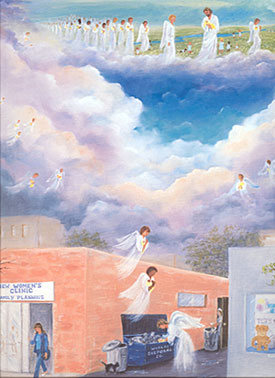
In this anti abortion poster
Heaven above waits
to receive aborted foetuses rescued by angels
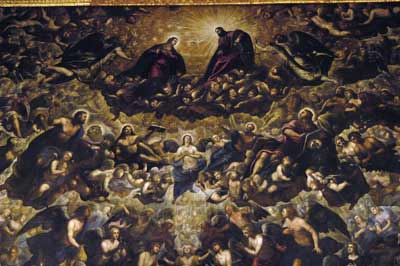
From my pre and perinatal psychological
perspective, the notion of Heaven, pictured here in a huge
Venetian mural, is an icon that resonates with, and gives a name to the
body memories of
the foetal ‘paradise’ of the first two
trimesters of
fetal life, where for most people, all bodily needs are being
effortlessly met
through the mother’s biology.
Complementary to Heaven, there is the notion of Hell, an imaginal landscape of eternal pain and punishment. This resonates with, and gives a name to, the galaxy of
painful bodily experiences of pain due to foetal distress and abusive child rearing and
the accumulations of what historically,
for many people, seems often to have been a hellish experience of daily
life.
.
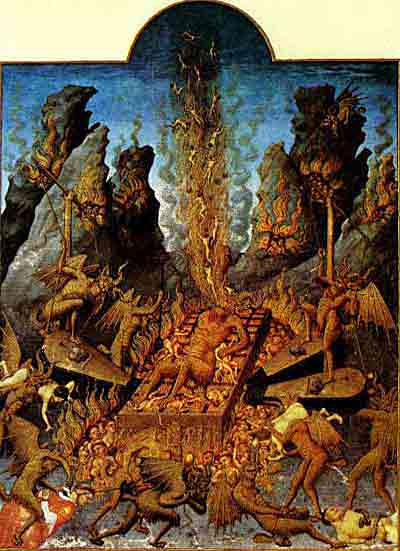 Duc de Berry Book of Hours
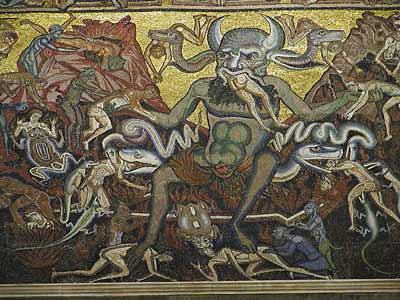 This mosaic of Hell is in the Baptistry in Florence
Alongside all
this sits, what I have
recently begun to recognize as the
undeclared
pantheism of christian sainthood.
Top of the list Mary, the 'good mother'
that,
as psychohistory shows, historically few, if anyone, had. Until relatively recent times absent
fathers were normality, mothers did the enforcing and socialising of
children. Mary
provided an idealized mother who can be appealed to for the sympathy,
support, commiseration and caring that was
missing from either a person's childhood, or their daily life, or both.
This seems to have been especially relevant for the
multitudes of women struggling to
survive hurts,
injustices and grief in a male dominant
world.

'May Our Lady model of purity, bestower of graces,
obtain for you all
heavenly gifts.
Mary, the only high visibility icon of papal
christianity that has feminine resonance, is loaded with
contradictions, beginning with the virgin pregnancy—could
claiming divine intercourse have been a neat way of avoiding being
stoned to death for adultery? And to delight misogynistic eyes, here is
a woman undefiled by sex. How were the poor faithful supposed to go
forth and multiply?
This ceramic of the Virgin Mary belongs to a home for
abandoned children
in Florence, open for four centuries until 1870. It seeks to entrance
inmates into accepting two of the prominent features of papal
christianity: hubris and
servility.
The Christ child holds a
scroll reading 'I am the light of the
world,'
Mary's finger points to a message that tells
women that 'the Lord has been mindful of the humble state of his
servant'. |
And then
there are the iconic 'fathers', the Father in Heaven and the Holy
Father... and
the father in the parish church.
Imaginal landscapes
The trance inductions of papal Catholicism, are centred on
churches, theatres where its rich imaginal landscape of liturgy and
ceremony
are organized and orchestrated.
 The Duomo Florence
The population of this landscape includes:
(note the capitalization
signaling
iconic value) a Holy Trinity, a Holy Ghost, a Holy Book, a Son, and a
Father,
the Virgin Mary, The Lord, Saviour, The Devil, Satan, Angels, Saints,
Miracles, a
Virgin birth, Purgatory, Hell,
Life
after Death, A Garden of Eden, and Heaven.
But when on the tourist
trail we visit the imaginal spaces
of ancient i.e. pre-protestant churches and cathedrals, there is little
to inform us that historically, for the general population, hearing
mass in
the
churches of christendom was to be witnessing a remote
ceremony, with chanting, bells and incense, conducted by priests
distant and out of sight behind the altar screens. A process that
underlined
the kind of ambiguity that an effective screen for projection requires
if it is
to keep alive adherents' psychic dolls.
Going
to
church—'hearing mass', taking communion, and
contemplating the panoply of saints, having a Son of God who shares our
pain, having a Book that details what is right and true about life, and even
that
there is an end to pain in the heavenly after-life to come—glued in
place by
the trance inductions of faith—all these provide a
spell-binding set of potent iconic
characters set in a
rich imaginal landscape. Together they form a very effective receptacle
for the projection of inner turmoil and pain.
Dominance damages
Historically
papal Catholicism may have been an adequate way of meeting the survival
needs
of, by
modern standards, comprehensively traumatized populations (for details
see Lloyd deMause:
The
Evolution of Childrearing). In the light of current knowledge about
persons and how
they
develop, Catholicism’s archaic, pre-psychological insistence on the
exclusive
ownership of the Truth about persons now seems to me equally
comprehensively
damaging:
- in direct
contradiction of the
Jesus
message of ‘love thy neighbour as thyself’, papal Catholicism models
and
broadcasts
dominance, legitimizing
it as natural and inevitable, perpetuating the damage that
arises due to such abuses of power wherever they occur;
- papal catholicism is palliative not
transformative;
- the group consensus trance it
embodies is
the antithesis of inquiry and disallows innovation;
- despite all this, too many world leaders still give adulatory attention to
papal Catholicism and some are, at least notionally,
signed
up to it.
- the institutional culture papal Catholicism
models and promotes versions of human power
relations that,
alongside demeaning and side-lining women, half of the population of
the world,
helps continue, by other means, the European colonization of the South.
The
Vatican curia has 114 white western Cardinals (38 of them from Italy)
24 from
Africa and the middle and far east and 28 from 'Latin' America. And
might it be racist too? A devout catholic I know,
recently returned from Poland, reported that the
grass roots
view there on
the recent
election of Cardinal Ratzinger as successor to
John Paul II, was that 'it was a choice between a sick man and a black
man, and of course the sick man won'.
- the papal
monarchy, like
other monarchies before and after
it, is damaging because it denies self determination, the power of
persons
themselves to find, or create, a spirituality that meets their needs,
rather
than the needs pre-ordained by a remote, dogmatic
institution.
Especially, through the splitting of spirit from body, it also tends to
close off
the essential daily task of finding of the sacred in the secular, a
task
that I
feel is now vital for human and ecological survival.
- papal
Catholicism's
notion of ‘original sin’, an
artifact of the political
accommodation
between christianity and imperial Rome and its
companion, ‘evil’, contribute to a profoundly pessimistic model of human nature.
- Buying
into the trance inductions of crucifixation and ‘original sin’ and
‘evil’, supports 'bystanding' the damage that cultures of domination
such as papal Catholicism entail. We
don't
have to take responsibility for interrupting the
ugly truth that childhood violence and sexual
abuse
often lay down intolerable bodymind pain that some people feel
compelled to
re-enact in violence on others through murder, assassination and
warfare. We can collude with others in failing to take account of the
extent to which cultures of domination such as papal Catholicism are taking us in the direction of
ecological disaster.
To summarize, the Catholicism of John Paul II is
damaging because it provides a consensus group
trance way of
containing or defending ourselves against the hurts, humiliations,
confusion,
sadness, fear and anger that we suffered when we were young, and maybe
not so
young, and which we carry with us as body memories and thus body
posture,
character, values, beliefs, and personality formation. The earlier and
more traumatic the
hurt,
the deeper it takes root in the formation of personhood and the more
likely it
is that current events that echo the original situation will
're-stimulate'—trigger regression in us to experiencing that hurt
again.
Since none
us wants this, we do what we can to keep away from such
situations, through
aversion, a built in compulsive flinch/flight from, or a compulsive,
needy
clinging on to anything or anyone that promises to keep us out of the
early
traumatic feeling. Papal Catholicism does this very well,
ensuring that we don't develop the emotional competence that would
enable us to attend to and resolve the occluded history rather than
hide from it.
Flight from modernity
Papal Catholicism, an arm of 5th century imperial Rome that
intrudes into the 21st century, is understandably in flight from
modernity, it
is
intentionally a pre-modern, pre-scientific,
pre-psychological institution. This
would be
fine by me if it was only one voice at the global meeting of minds
but this
is a loud bullying voice, ruthless in its love of power.
Its compulsive
holding to its archaic political origins denies, and is intended to
deny,
the opening up of human rights, the extensions of democracy and human
knowledge of the last century. It denies this because to embrace it
would undermine its dominance. And yet what at root is the modernity it
denies?
Yes, there are still injustices and contradictions, but the
developed
world features innumerable interlocking technical and ‘knowledge
cultures’
—traditions of
research
and inquiry—built
on several centuries of human research, in physics, mathematics,
astronomy, biology, medicine, sociology and psychology. Even
though corporate colonization of knowledge, or
strangulation of it at birth, is common, the fruits of these cultures
of
inquiry
amount to an astonishing flowering of humankind that is becoming
very widely
diffused and enjoyed.
One of the fruits of
such enquiry is the sharpened perception that single big
ideas—single accounts of how and why—are likely to denote tyranny—the
imprisonment of
intelligence, not infrequently in steel and concrete gaols. Papal
catholicism is ultimately in denial of the realization that at this
point in history the
intellectual territory of single big ideas is irreversibly mutating
into the uncertain
landscape of post-modernity,
where
human survival depends on meaning and value being more and more
negotiated rather than dispensed. A world view that paradoxically appears to closely resemble that of 1st century gnostic christianity.
And
yet threaded
through these, albeit improved,
accounts of the worlds we inhabit, domination still seems to prevail,
and the
accumulations of damage due to dominance-driven living continue to sediment into the
impending
catastrophe of humanly generated global warming.
Which brings us back to papal Catholicism. In modelling top down
hierarchical bullying, both institutionally and in its compelling
trance inductions, papal Catholicism insists on a fatally attractive apolitical equation—that
change, particularly if it involves social justice, is not only
impossible but wrong. This is
not to blame papal Catholicism for our impending ecological threat but
to see
its ethos of dominance as feeding the imperial,
bullying,
colonizing approach to nature which, literally in the name of
god, is a
precursor of the
ecological
damage we are confronting today. While promising a solution to human suffering through obedience to the tenets
of faith, it actually epitomizes the
over-arching
problem humankind faces—that dominance damages.
Conclusion -
Brand managing human nature
In claiming possession
of a
uniquely ‘true’, or ‘correct’ vision of spiritual truth while denying
its
psychosocial origins, the
papacy of
John Paul
II
propagates
a way of framing human
nature that
institutionalizes,
behind declarations of the power of
love, the reality of the love
of
power.
However papal
Catholicism is
not only a living embodiment of the love of power, it also
teaches
us how to manage political power. The Vatican, proprietor of
christianity, perhaps the biggest and first among all brands, was an
early,
if not
the first, developer of brand management,
How does this apply to papal Catholicism? Brand management
functions through attaching an entrancing feeling or quality to a
product or service. In the case of papal catholicism consumer attention has already been flooded by centuries of positive
feedback
loops (the more we hear of a notion or an idea, the more it seems to be
true) through preaching,
teaching and evangelizing christianity. Protecting the brand through iconic resonance with saints and the 'deposit of
faith' as the Vatican calls it, plus re-iterations of exclusivity
and the elimination of rivals and dissent—ensures that papal catholicism holds its place in the
spiritual marketplace.
Because so many people take dominance in human relations to be natural,
in
such a brand management
approach
to truth-telling, the trance inductions that get financed and
institutionalized, such
as the papacy that we examine here, seem overwhelmingly likely to be
those
that shut down open enquiry and that preserve, extend and entrench the
power status quo, typically
that of
top down authoritarian relating.
The phenomena of
mass communication of the last 100
years, epitomized by the media coverage of John Paul II’s funeral, challenge papal Catholicism by bringing other world views into catholic
living rooms but it also hugely amplifies its capacity to
promote its
brand of christianity—to generate, sustain, and deepen its
spellbinding trance
inductions. Through
them, huge
populations in post-colonial South America, Africa and the
Far East
have come to subscribe to a damagingly narrow range of intrinsically
western
notions about what is human and natural about humankind and the planet
we
inhabit.
So far as it is
domination that is regarded as natural and
inevitable, this amplifies an especially dangerous situation. Not least
because
it provides a parallel 'moral' model supporting that of the
George
W. Bush administration,
the US military corporate imperium and its
globalizing allies, who
are also presently trying to impose the godified righteousness of a
'new
world
order' on the entire planet, while ignoring the
over-arching threat of
global
warming.
In an earlier draft of
this piece (most of this text was
written in the days after Pope John Paul's funeral) I wrote:
’So far
as Catholicism remains resolutely pre-psychological, (and at
least in
Europe, in decline) we could expect it be even more fundamentalist in
its
denial of the power of love and more devoted to the institutional
protection of
it gives to the love of power. Look for signs of this in the choice of
a new
pope.’
Since then came the
news that Cardinal Ratzinger head of the present day papal inquisition,
headlined as '
God's
Rottweiler' - Daily Telegraph and the
'Vatican's
enforcer' - National Catholic Reporter, close friend of Pope John
Paul II and thus someone who no
doubt
had a big hand
in the
selection of the almost all the cardinals who voted for him, has been
elected
as John Paul's successor.
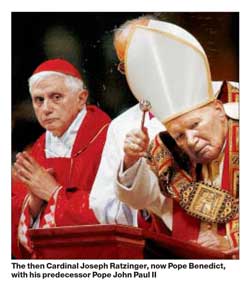
Leaving aside the
religious faith
dimensions, or the mafia qualities of the Vatican curia, behind all the
spells
and incantations, these men wearing the silk threads of
infallibility on
moral issues, are in the modern corporate business of defining what is,
or is not,
human nature, what behaviors and relationships are human and natural.
For any
such power, to be concentrated locally as it is in Rome with the global
reach
of international papal Catholicism, especially if it equates eternal
with
inevitable,
is an ever-present danger. Domination damages.
In case you are inclined to see this
present line of enquiry as
inadequately
rooted in other research, I'll end with George Lakoff’s almost poetic
unravelling of the christian faith consensus trance as a metaphor.
MORAL
ORDER
The metaphor of Moral Order fits
naturally with the metaphor of Moral
Authority, as well as with the literal parental authority central to
the Strict
Father family. This metaphor is based on a folk theory of
the
natural order:
The natural order is the order of
dominance that occurs in the world.
Examples
of the natural order are as follows:
God is naturally more powerful than
people.
People are naturally more powerful than
animals and plants and natural
objects.
Adults are naturally more powerful than
children. Men are naturally
more
powerful than women.
The metaphor of Moral Order sees this
natural hierarchy of power as
moral. The
metaphor can be stated simply as:
• The Moral Order Is the Natural Order.
This metaphor transforms the folk
hierarchy of "natural" power
relations into a hierarchy of moral authority:
God has moral authority over people.
People have moral authority over nature
(animals, plants, and natural
objects).
Adults have moral authority over
children.
Men have moral authority over women.
.....
The Moral Order metaphor plays a
crucial role in an important
interpretation of
the Judeo-Christian religious tradition. It is an entailment of this
metaphor
that God cares about human beings in the same way as parents care about
their
children or shepherds care about their flocks or farmers care about
their
crops. Logically, after all, there is no reason that a supreme being
should
care about lesser beings. But if the order of dominance is a moral
order, then
God does care about mere mortals; setting the rules and enforcing them
is how
he shows he cares, and in return for his care, we owe him obedience.
The consequences of the metaphor of
Moral Order are enormous, even
outside
religion. It legitimates a certain class of existing power relations as
being
natural and therefore moral, and thus makes social movements like
feminism
appear unnatural and therefore counter to the moral order. It
legitimates
certain views of nature, e.g., nature as a resource for human use and,
correspondingly, man as steward over nature. Accordingly, it
delegitimizes
other views of nature, e.g., those in which nature has inherent value
.
George Lakoff Moral Politics 1996
__________________________________________
Media
comment on the papacy of Pope John II
Polly Toynbee 8th April 2005
...
a
modern, potent force for cruelty and hypocrisy.
Here is a long, well-researched
Mother Jones article
detailing the
CIA's
involvement with the Vatican from WWII on.
Jonathan Steele Friday April 8, 2005
We
are
rewriting the history of communism's collapse. It was Gorbachev,
not the
Pope, who brought the system down
Terry
Eagleton
The
Pope has
blood on his hands The Pope did great damage to the church, and to
countless Catholics.
Matthew Fox
Reflections
on Pope John Paul 2
Peter
and Margaret Hebblethwaite, and Peter Stanford
John
Paul II Obituary:
The Guardian
Ellen Goodman Washington
Post Writers Group
Pope
John Paul II
Cardinal Ratzinger Fan Club
Yes, there is one! Here is a sample extract:
'...
As Grand Inquisitor for Mother Rome, Ratzinger keeps
KEPT himself busy in service to the Truth: correcting theological
error,
silencing dissenting theologians, and stomping down heresy wherever it
may rear
its ugly head -- and, consequently, had received somewhat of a
notorious
reputation among the liberal media and 'enlightened' intellegensia of
pseudo-Catholic universities....'
Cardinal
Ratzinger - Could the Next Pope Be a Nazi?
Some blog reflections on the papacy that are more intelligent than
the
title suggests.
Joan Chittister,
OSB
, Antigone
or Ismene: the
new choice
Paul Collins,
Australian theologian and broadcaster
argued
at the
intriguingly titled
We are Church group
press conference during
papal
election week that:
“the
legacy of John Paul II... was
“reactionary, with no sense of contemporary theology, biblical studies
and church history.” There was “no demonstrated understanding of
the
historical conditioning that gives context to all philosophy, ethics,
and theology.”
Cardinal
Ratzinger, he told reporters, “while profoundly aware of recent
developments in western theology, shared the same historical amnesia.”
...the Wojtyla papacy has been
an extreme realization of papal extremism...
...the
curia itself must be abolished. As a relatively late invention of the
17
century, spawned in a period of absolute monarchies, the centralized
departmental structure “is not constructed in a way that can respond to
modern
questions.”
Nor, Collins implied, can they, coming out of a mind set formed
in a
royal court, reform themselves... the health of the church… is in
danger of
suffering from too much papalism, excessive centralization beyond any
historical norm… and a male-centeredness that makes invisible half the
population of the world.
Professor Adriano Valerio, a professor of Church History at the University of Naples
and
President of the European Society of Women in Theological Research, pointed
out at a
the same press
conference
that there are 600 women
Catholic theologians
in Europe who are studiously ignored by the Vatican and can only have a
voice
in secular academia:
“Women
have
spoken and written texts that are invisible today,” she said. “They are
lost to
the historical memory of the church. The first thing a new pope would
have to
do is to give people freedom of speech. Women theologians have none in
the
church. If she speaks in public, it’s because she speaks at a secular
university. If she taught in a Catholic university and said these
things, she
would be punished. This includes males who themselves support women's
ideas, as
well.”
And then a few weeks later, there was the reception in some media of
John
Paul II's
successor.
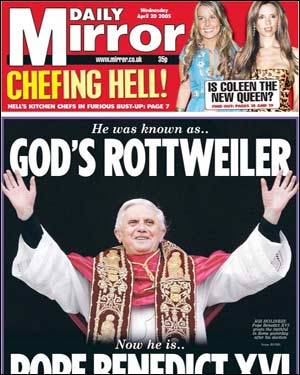
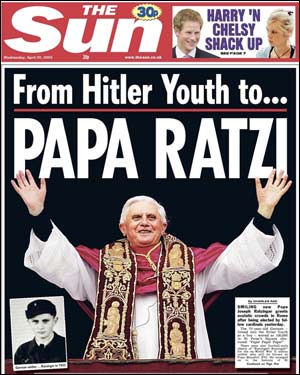
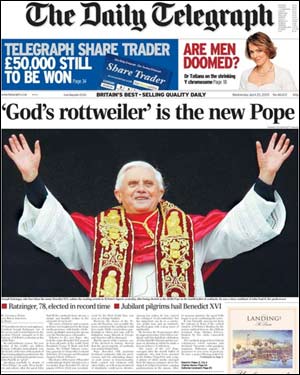
There are 0 writeback comments for this entry
posted at: 12:19 | permanent link to this entry
Fri, 08 Jul 2005
Cultures of domination
The
Holy Enemies of Pax Americana, its
mirrors in militant
fundamentalism, and
papal Catholicism's love affair with power all seem transparent examples of institutional domination. So much so that we can fail
to notice that the excesses of the imperia we have elected, or adopted,
or had thrust upon us... torture, state terrorism... the killing and
traumatization of civilians... are on a
continuum that includes the world we inhabit and support.
I call this continuum, a
culture
of domination, a multi-threaded mix of custom and practice,
close at hand, in us and around
us, that makes the bullying, victimhood and damage of domination
seem natural and inevitable.
As evidence of this naturalisation, to bring it into awareness, I
collect images of my local cultures of domination. Take a look at the selection
of them below. I've found, as I hope you will, that rather than
seeming to be a given, like the weather, by bringing them out into the light of day they
become more susceptible to choice, interruption and
confrontation. And less undermining of 'living from love'.
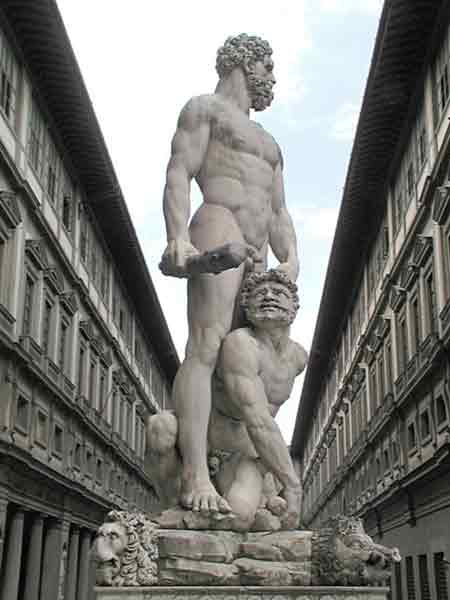
One of the high status locations of European civilization, the Uffizi
Gallery
in
Florence.
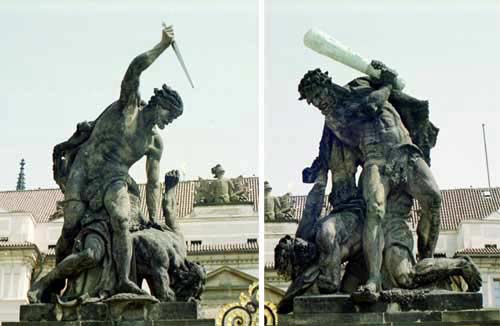
Figures on the entrance gates to the Royal Palace Prague.
High up on an outside wall of San Marco in Venice, Hercules teaches
someone a lesson.
Hercules again.

In a shop window near where I live, this banner and the toys (below)
that it promotes, introduce young boys to the delights of
bullying and violence.



Smash! Crunch! Toy on sale in an Italian market.
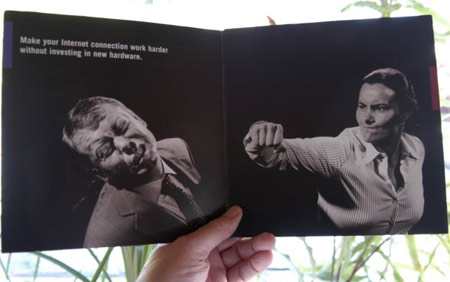
For some reason an Internet provider thought this direct mail offer
would be just what I needed.
Music can be violent too, have fun with The Killers.

Or if The Killers aren't enough, try TeamKilling.
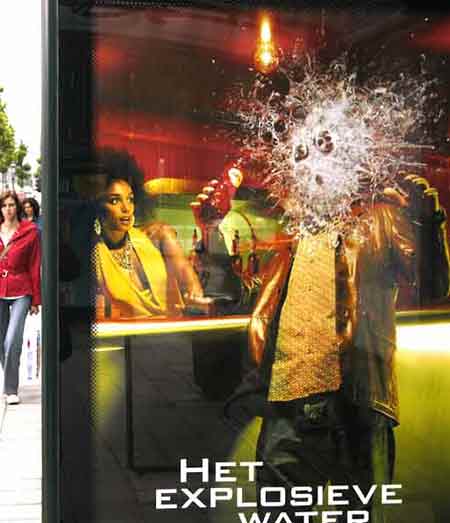
And in Brussels in the weeks and months when Iraq is still being torn
apart
you could enjoy violently explosive bottled water.

Old wars can be such fun as well! Video game advertised on the London
Underground.

A weeks long advertising campaign in Belgium for the local lottery
took the form of a naval battle (here and below).
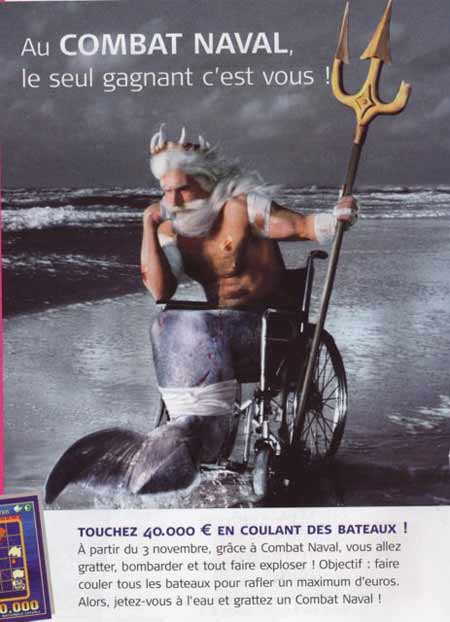
Translation: In Sea battle! the only winner is you!
WIN EUR40,000 BY SINKING SHIPS
As of November 3, thanks to Sea Battle you will scratch, bombard and
explode everything! Aim: sink all the ships, reap in a maximum of
Euros.
So, throw yourself in the water and scratch a Sea Battle!

Of course people do get hurt in naval battles but it's still such fun
to win them isn't it?

Summer 2005 saw shedloads of people, royalty included, having fun
celebrating the deaths of over 4000 sailors in a reenactment of the
Battle of Trafalgar.

Why limit our fun to sea battles? Let's have Total War.

Enhance the fun of the computer games violence, run these games on a
weaponised
PC.
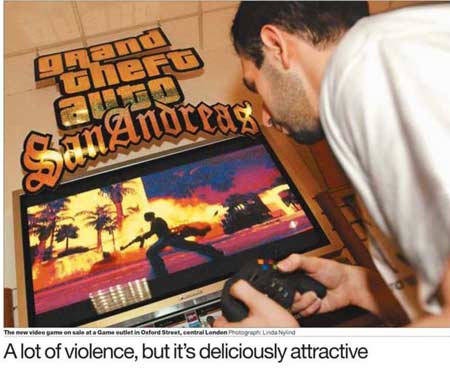
As the headline admits, cultures of domination legitimize violence and
hide the damage,
distress and traumatization that it
entails. Either, as in video games, by creating virtual worlds,
or
though splitting/dissociation, becoming entranced, so that the
consequences of our actions drop out of awareness.

The 'warrior', pinnacle of (prepsychological) manhood.

The 'warrior' again, have fun 'killing people and breaking
things', as a marine in Iraq described his work .

More warriors as heroic entertainment.
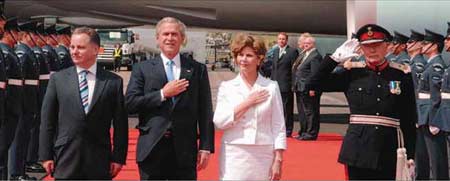
Still more warriors, note the touching body language.
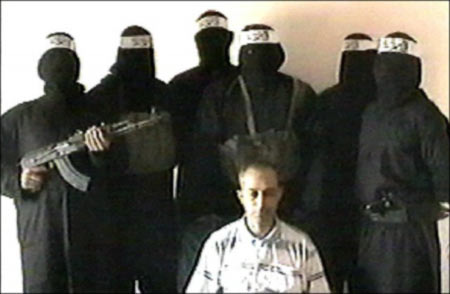
More warriors, they also have God on their side.

In this picture from the Abu Ghraib series, note the man with his
underpants pulled down, for reasons of 'abuse' of course, not
'torture',
and the green gloves on the standing soldier, could they
be...? No, surely not... the green hulk gloves you saw earlier?
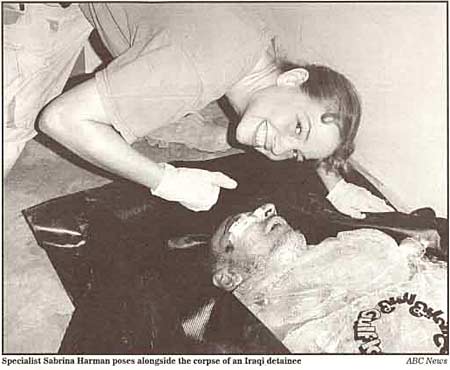
A female Abu Ghraib warrior entertaining herself with a corpse
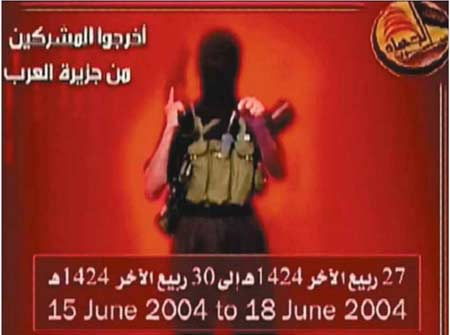
Another warrior ready and willing to show that,
through video executions and suicide bombings, he too will stop at
nothing to demonstrate that he and his allies have the will and the
means to match US efforts to dominate the world.
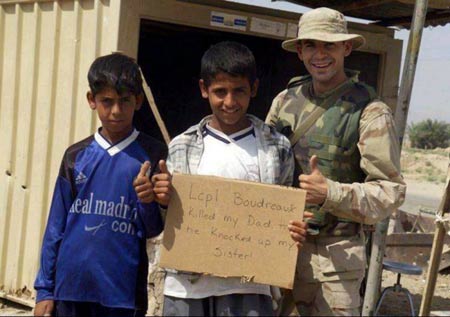
Go to Iraq. Kill. Break things. Have fun with the locals.
"Lcpl Boudreaux killed my dad and he knocked up my sister"
Evidence
that photo is not a fake

Heroic Triumphalism as the US exits Falluja after the failed first
siege.
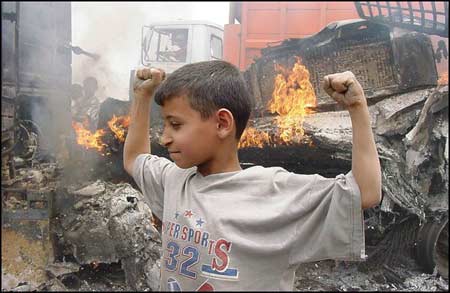
Oppositional Defiant Disorder Iraq-style

Delivering 'freedom' and 'democracy'.
This, I seem to recall, is an image of the US military visiting the
Falluja
hospital in the early days of the
second attack on that city.
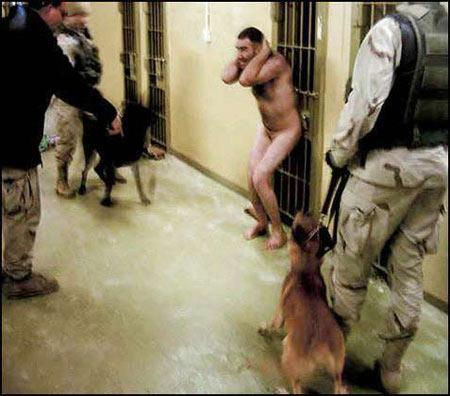
Abu Ghraib: The US press and administration calls this 'abuse' to
hide the pain, suffering and subsequent traumatization that calling it
'torture' would bring into
the daylight.


God's army at work in Iraq.
'Thank you O God for surrounding
our personnel, their families,
and our allies with your favour and your faithfulness.
Deploy your Host from heaven so that your will for America will
be performed on earth as it is already perfected in Heaven'. From
Rev. Kirbyjon Caldwell's Benediction at the 2005
Presidential Inauguration

God's army works in the music industry too. Christianity under threat?
Or
christianity will blow you away?
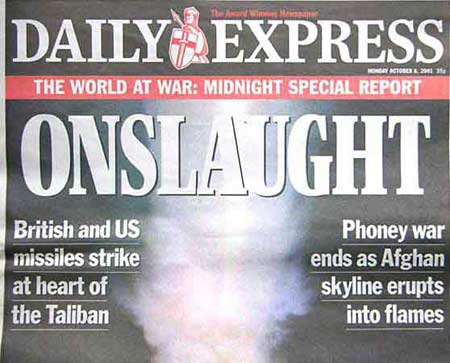
God's army at work in the press. The Sword and the Cross. Conquer the
heathen... Repel the infidel! This
UK newspaper has had a crusader on its masthead for as long as I can
remember.

Video game: have fun killing Islamists!

Cinema: spirituality crusader style

Jesus Saves! Join this crusade to discover the perfect fit between the
Jesus message and an attacking eagle!

Think again it says. Yes, some
animals
are natural born killers but why, during a
failing attack on Iraq by the overwhelming military resources of the
US, should we be so so interested in predation?
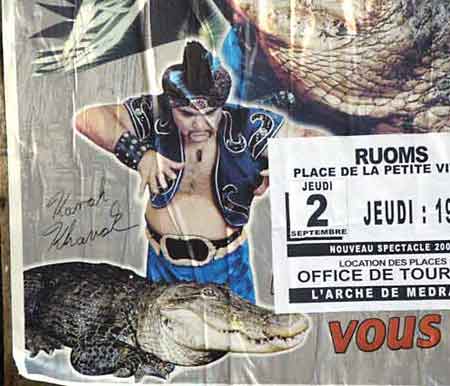
Curious.This violent predatory animal has a strongly middle eastern
flavour.

Find another violent predator... show that you can overcome its
resistance
and impose your will on it... demonstrate your dominance.
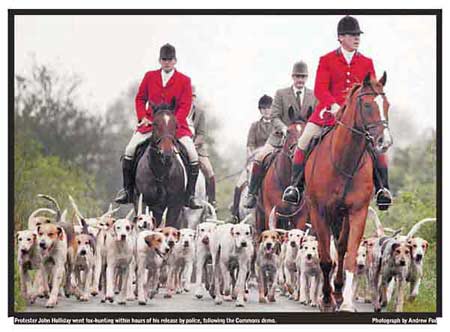
Buy a horse, take out a subscription for some hounds. Hunt and kill a
violent predator... show that you can impose your will on it...
demonstrate your dominance, reinforce the naturalness of it with
archaic dressing up.
Another man riding high on a horse. One of the classic hypnotic
images that entrance us into the belief that dominance is natural and
inevitable. Few European cities are without several examples. This one
is in Venice.

In this 2004 presidential election photo opportunity, John Kerry proves
that he too subscribes to core American family values... he too enjoys
killing for fun.

More core American family values... This Texas shop stocks
camouflage hunting clothes for children
(picture courtesy of IB)

'Don't wait to introduce your favorite baby to the great outdoors! This
adorable little romper will be a hit with friends and family', from a
women hunters web catalog

Oh yes, and genocide can be fun too.

Appropriate an icon of leadership, the Native American Chieftain,
delete
the pain and suffering that the genocidal destruction of his culture
entailed and use it to promote your West London restaurant.

Appropriate 'Cherokee Nations' as an icon, delete
the pain and suffering that the genocidal destruction of their culture
entailed and use it to promote your SUV.
What next? The 'Auschwitz Special Edition' from Mercedes?

Complete and absolute control... especially over bodies.

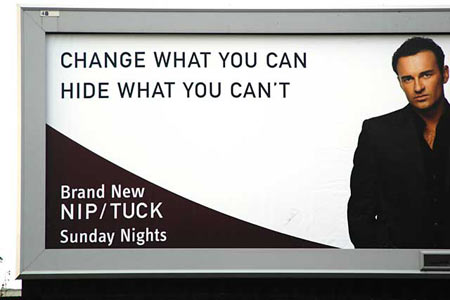
With complete and absolute control even the damage and pain of surgery
can be entertaining fun.

Buy yourself another face, Michael Jackson did.

Have fun mutilating yourself, this woman does
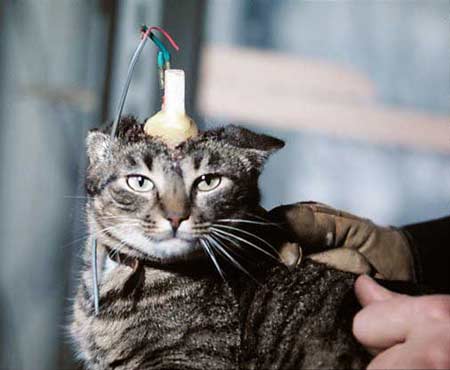
If we had total control... of what happens in the brain.... then maybe
we could be permanently happy. Until then domination and abuse of
animals will have to do.
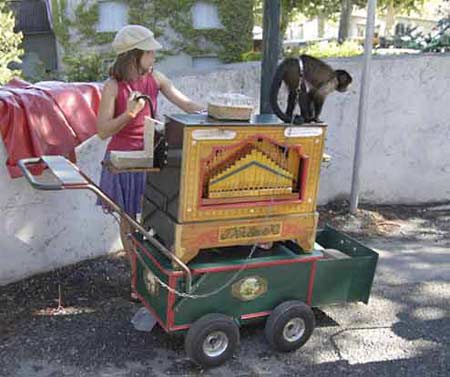
And the total control of grinding out the same tune day after day is
made attractive by having a fragment of 'nature' on a chain, or in a
flowerpot.

Total control used to mean swaddling babies so that they could be
hung up on a wall, or on the back of a door, out of the way of grown
ups.
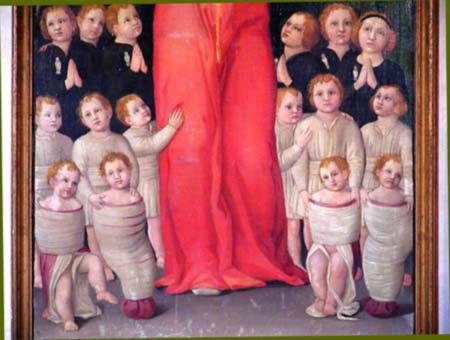
Total control used to mean that infanticide and abandonment were
commonplace. Until 1875, the hospital in Florence that owns this
picture had a public window through which you could post your unwanted
baby.

Total control used to mean
beating and tormenting
babies and young children to break their will, and to expel the
sinfulness of
their disobedience.
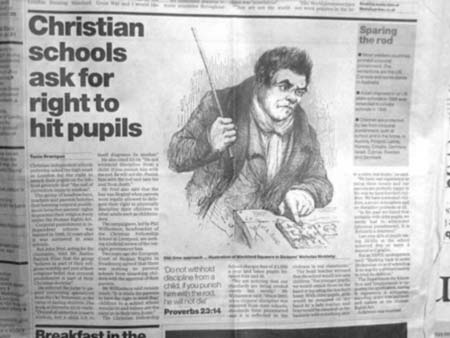 Two children under the age of 15 die from abuse
in the UK each week.
Two children under the age of 15 die from abuse
in the UK each week.
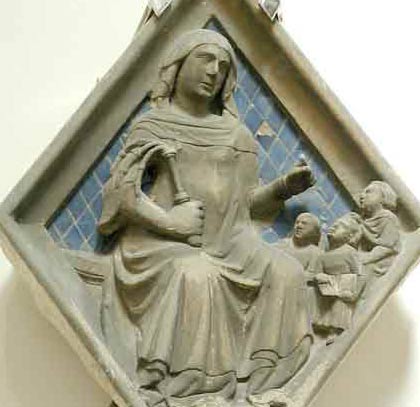
Loving care for children is historically quite recent. Extremes of
violence were commonplace in schools, workplaces and homes until the
middle of the 20th century, and
still are in some cultures.
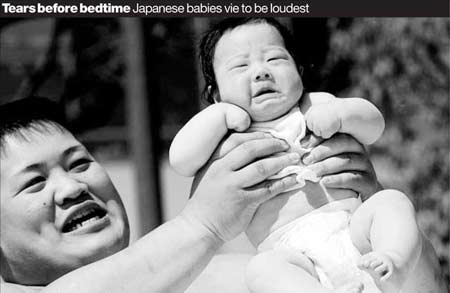
In Japan some people believe that distressed children grow up to be
big and strong. This baby is in a competition for the loudest crying
baby.
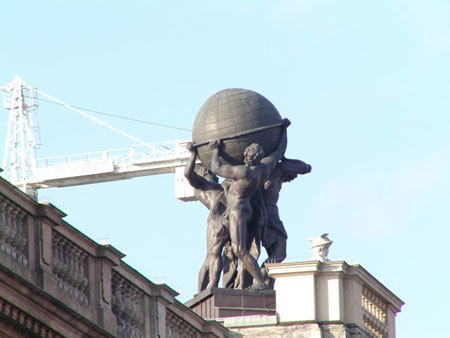
The illusion that humankind can own and thus control the whole world,
if only we could get a sufficient grip on it, isn't a new notion. As
witness this art atop of the Berlin Post Office c1875

Keeping an eye on the whole world.
'The mission of the Defense
Advanced Projects Research Agency [DARPA]
is to
maintain the technological superiority of the U.S. military and prevent
technological surprise from harming our national security by sponsoring
revolutionary, high-payoff research that bridges the gap between
fundamental discoveries and their military use'.
Translation: be
sure that for the US military 'full
spectrum dominance' means what it
says.
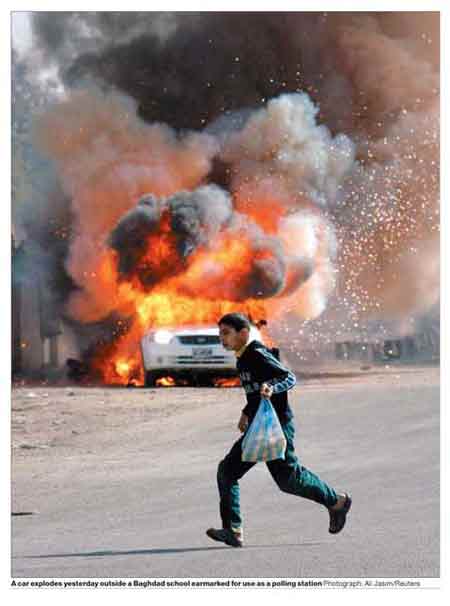
Unfortunately, what has been described as the the ultimate smart
weapon,
suicide bombing, seems to have got under the radar of the DARPA agency

Cultures of domination mass-manufacture victimhood

Ad in US magazine c1970

Street poster in Brussels

Ad in Belgian supermarket magazine

Jeans ad in Brussels

Ad in Brussels Midi metro station

Ad in Venice shop window
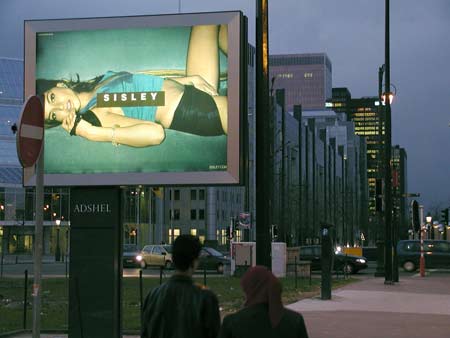
Ad outside government offices in Brussels.
Many women don't need to be reminded of the cultures of domination that
seek, literally and metaphorically, to shape them and their
preferences,.
Many more seem only too willing to buy into the notion of becoming some
form of sexual
commodity.

And, if even Emotion can become a commodity, what is ruled out?
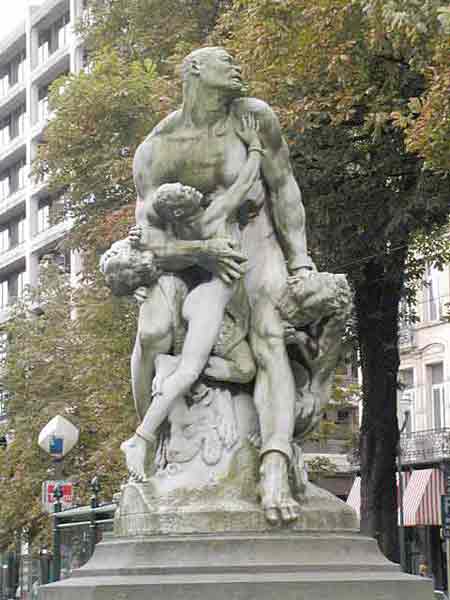
I've never been able to make sense of this statue at a tram stop in
Brussels' Avenue Louise. A terrified, manacled negroid boy and a
manacled non-negroid man being eaten by two lions. Victims of
Belgian care for the Congo?

I've never been able to make much sense of this Brussels car ad either.
Doesn't
look much like love to me.
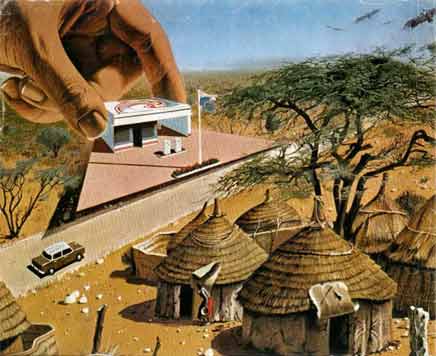
This French ad is from a time when petrol companies still thought ever
expanding markets were good business.

Another example of how cultures of domination legitimize violence.
Making a disconnect, as in this UK high street product, between images
of
harm and the felt experience of having your fingers amputated.

Here is another example of disconnect. Hands torn from an unknown
person coupled to a smile of pleasure.

Yet another disconnect. The necklace being admired in this Belgian ad
is
described as a 'Créateur d'émotion'. What kind of emotion
do you think the dog trapped outside the lift is going to
feel?
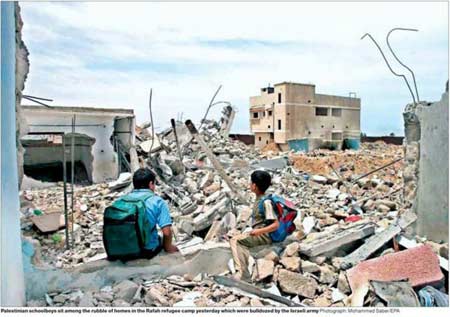
It takes a disconnect to enable, or bystand, this Israeli
destruction in the
Gaza refugee camp of Rafah. The same disconnect sustains ignorance of
the
probability that
the traumatization of such children will still be shaping their values
and motivations for generations.

Honour the birthday of Jesus, get a gun for Xmas

'High octane', 'explosions', 'blow away the competition'. Damage-free
warfare talk.

Free post card from a local café

Free post card from a local café

Free post card from a local café

Disconnect the damage and pain from violence and what are you left
with? Mr and Mrs Average?
'It starts with them saying to
a therapist that they have
an "average" marriage. Then it shows their jobs, both of them,
neither of them knowing about the other, involve endless hired
killings, for no particular reason indicated in the movie. Half
way through their endless killings they (for no particular reason
indicated in the movie) go after each other to kill their
spouses. Then, near the end of the movie (we finally walked out
in disbelief), a couple of gangs try to kill both of
them, with endless explosions. Now you know how an "average
marriage" feels these days.'
Elist message
This is the last frame of a TV promotion run in the summer 2005 by the
BBC's Channel 3 that consisted of scenes of people killing or
being killed.

'Powerful stylish', 'a shot in the arm', 'gripping'. 'You get
only one shot at life'. More damage-free warfare-talk.
More 'spectacular', 'stylish', and 'provocative' guns at the heart of
musical entertainment

As I guess most of the world knows, the 'terrorist' the headlines refer
to was a Brasilian electrician unconnected with the recent bombings in
the UK, who was killed by eight bullets from armed police while held
face down on the floor of a London underground train.
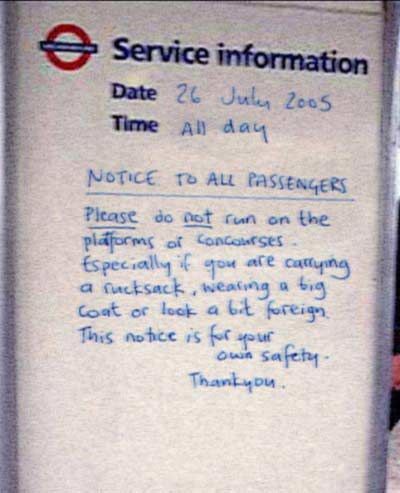
Notice in London's Notting Hill Gate underground station.
Service information
Date 26 July 2005
Time All day
NOTICE TO ALL PASSENGERS
Please do not run on the
platforms or concourses.
Especially if you are carrying
a rucksack, wearing a big
coat or look a bit foreign.
This notice is for your own safety.
Thank you.
There are 0 writeback comments for this entry
posted at: 07:08 | permanent link to this entry
Fri, 21 Jan 2005
The Texas Ayatollah
This inquiry is about the extent to which we (and nations) can be
entranced by a belief in the inevitability of our righteousness, of our
dominion, of our superiority. Once such trances are broken then the
world looks a different place. That was certainly true for me following yesterday's US Presidential Inauguration.
Forty years ago I was highly entranced by America, by its creativity,
its music, its culture, its vigor As an art student in London I
couldn't wait to get to the US. Visiting and living in the New York of
Thelonius Monk, and Gil Evans was to be the cream in the coffee. And I
drank so much coffee that I started a heart arrhythmia!
Returning to the US in the mid sixties, I made a film for the BBC about
MIT an organization which, when
I worked there, had seemed to
epitomize the intelligence and vitality of America. Called
How to be First, it was filmed in
the years before the moonshots, the inertial guidance systems for which
were being made at MIT. This was why, we supposed, our filming merited
the distant but persistent attentions of the FBI.
I saw this film again recently and was astonished to see how, naive as
I was politically; I had picked up the deepening American domination
trance. A trance kept glued in place as I saw it then, and even more
now, by the military
industrial complex (ably assisted by US network TV). I dubbed the music
of Dukas Sorcerer's Apprentice over pictures of the hi-tech denizens of
Cambridge's Route 128, Raytheon et. al., and over pictures of the cadet
parades at MIT (many students were on military scholarships) and raised the
question of whether a line had not been crossed between education and
militarism. The film, a mix of wonder, awe and shock is a good match
for my experience of MIT. Perhaps not surprisingly MIT tried and
failed to stop it being shown in the US.
Almost two decades later, when the insanities of Mutually Assured
Destruction were casting a notably more threatening trance, I had the
opportunity, along with a long term Action Research group to make
a film about it called
The Nuclear
State. In search of material that would ground
the group's unraveling of the spellbinding nuclear threat, I travelled
again to the US. After being certified by an official at the
Pentagon as no, or low threat, I trawled the vast film archives of the
US Air Force, later calling on a selection of
the main military industrial contractors eg Boeing, Grumman, McDonnel
Douglas. The trance-breaking, dissenting posture of the finished film
was underlined by its being seen as trash by the channel who had
commissioned it, and it took a public fight to get it transmitted.
But back to my theme, traveling the US for this film, visiting military
industrial
contractors, being in touch with the sheer scale of the military
industrial complex, further deflated the spell which the US cast and
which I had happily bought into. I came upon a whole town making
ammunition that described itself as 'munition-minded'; I realized
how deeply embedded military technology was, how many mortgages were
paid by people going to work every day making
nuclear-ready bombers, or packing cluster bombs that scattered plastic
shrapnel which didn't show up on x rays. As I arrived at Boeing, the
bus paused while a cruise missile was moved from one shed to another.
Reality sank in. I became increasingly convinced that the US was a
prisoner of the military industrial business, its science and
technology and as it seemed, its vitality, were being corrupted by the
huge scale (and the secrecy and unaccountability) of military
agendas and spending.
And yesterday's inauguration of President Bush, to the accompaniment of
tears of fury and disappointment on my part, demolished any further
remnants of the trance I might have been under regarding the US of A.
Heralded by a band playing
The
Saints Go Marching In, and preceded by Bush speech in which he
declared that 'we have a calling from... (slight hesitation) beyond the
stars', the sheer scale of the false front that the Inauguration
presented seemed beyond comprehension. Bush's blatantly trance-inducing
repetition of 'freedom', the mismatch between it and US actions on the
ground, not just this year but in preceding decades, seemed an
invitation to the whole world to shout 'liar'.
As though the context of the word 'freedom' always meant
freedom from... and had never
been used by US interests in the sense of
freedom to... control, dominate and
exploit. And yet around half of those Americans watching this farrago I
suppose were asleep to the second of these usages, or are busy
profiting from it.
I often think that a helpful guideline about
subliminal marketing techniques of the kind that the Bush and other
administrations deploy, is to assume that if there are a lot of
assertions about 'strength' or 'security', to presume this compensates
for, or denies weakness. The incessant repetition of the word
freedom in Bush's inaugural speech raises the question of where, how
and
for whom, is freedom about to be restricted.
A recycled cliché
So why did I find yesterday's Presidential Inauguration
so shocking? It was as though a
well-known person, a beloved friend, someone who had been a source of
delight and inspiration, showed up one day at a public event stark
naked and appeared entirely unaware of their nudity. Yes I know it is a
well-worn cliché but this emperor really doesn't have any
clothes and he doesn't know, doesn't apparently want to know.
According to Chas Freeman,
former US ambassador to Saudi Arabia and head of the
independent Middle East Policy Council, Mr Bush recently
asked Mr Powell for his view on the progress of the
war. "We're losing," Mr
Powell was quoted as saying. Mr Freeman said Mr Bush
then asked the secretary of
state to leave. Financial
Times 13-01-05
President Bush is a person who has no time for reflexivity. He has
'faith', he believes, i.e.
is
entranced by christianity
What ultimately got to me, what I felt as the deepest and most
profoundly hypocritical and thus shocking aspect of the Inauguration,
was that we seemed to be witnessing the swearing in of a theocracy.
Christian Americana oozed from every pore. The 'god beyond the stars'
seemed to be in every second sentence and in most of the music,
Bless This House... sung by
Susan Graham.
Bless this house O Lord we
pray; Make it safe by night and day;
Bless these walls so firm and stout, Keeping want and trouble
out:
Bless the roof and chimneys tall, Let thy peace lie over all;
Bless this door, that it may prove ever open to joy and love.
Bless these windows shining bright, Letting in God's heav'nly
light;
Bless the hearth a'blazing there, with smoke ascending like a
prayer;
Bless the folk who dwell within, keep them pure and free from
sin;
Bless us all that we may be Fit O Lord to dwell with thee;
Bless us all that one day we May dwell O Lord with thee.
The Cheney women held the family bible while The Vice President was
sworn in then Denyce Groves sang
The
American Anthem,
a dreary patriotic song composed by outgoing Attorney General Ashcroft
. President Bush swore his oath
and made his
Inaugural
speech. This was followed by several military bands and choirs
singing and playing
God of our
Fathers.
God of our fathers, Whose almighty hand
Leads forth in beauty all the starry band
Of shining worlds in splendor through the skies
Our grateful songs before Thy throne arise.
Thy love divine hath led us in the past,
In this free land by Thee our lot is cast,
Be Thou our Ruler, Guardian, Guide and Stay,
Thy Word our law, Thy paths our chosen way.
From war’s alarms, from deadly pestilence,
Be Thy strong arm our ever sure defense;
Thy true religion in our hearts increase,
Thy bounteous goodness nourish us in peace.
Refresh Thy people on their toilsome way,
Lead us from night to never ending day;
Fill all our lives with love and grace divine,
And glory, laud, and praise be ever Thine.
As I have observed here before, lots of god and not enough love. There
was more to come in the Rev. Kirbyjon Caldwell's Benediction
Oh Lord God Almighty
The Supply and Supplier of faith and freedom
How excellent is Your Name in all the earth
You are great and greatly to be praised
Oh God, as we conclude this 55th inaugural ceremony
We conclude it with an attitude of thanksgiving
Thank you for protecting America's borders
After all, as the psalmist reminds us
Unless you O God guard the territory our efforts will be in vain
Thank you for our armed service personnel
And it is with our unswerving thanksgiving that we pause to
remember the persons... who have made the ultimate sacrifice to help
ensure America's safety.
Thank you O god for surrounding our personnel, their families,
and our allies with your favour and your faithfulness
Deploy your Host from heaven so that your will for American will
be performed on earth as it is already perfected in Heaven.
I confess that your face will shine upon the United States of
America, granting us social peace and economic prosperity
Particularly for the weary and the poor
I also confess Oh God that each American's latter days will be
better than their former days
Let it be unto us according to your word
Rally the Republicans, the Democrats, and the independents
around your common good
So that America will truly become one nation under god
Indivisible
With liberty justice and equal opportunity for all including the
least, the last, and the lost.
Bless every elected official right now
Oh God I declare your blessings shower upon our president George
W. Bush
Bless him, his family, and his administration
I once again declare that no weapon formed against them shall
prosper
And God, forgive us for becoming so ensnarled in petty partisan
politics that we miss your glory and flunk our purpose.
Deliver us from the Evil One
From Evil itself.
And from the mere appearance of Evil.
Give us clean hearts so that we might have clean agendas, clean
priorities and programmes and even clean financial statements
And now unto you Oh God the One who always has been and always
will be the one King of Kings and the true power broker
We glorify and honour you
Respecting persons of all faiths, I humbly submit this prayer in
the name of Jesus Christ
Amen
Why do I include so much of this stuff? Partly because it epitomizes
trance induction but mostly because of the disconnect it entails, even
celebrates. Sitting behind Kirbyjon Caldwell as he delivered his
Benediction were rows of people who have either endorsed, or are
prepared to bystand, the legitimizing of torture, imprisonment without
trial or access to lawyers, and the indiscriminate bombing and shelling
of women, children and non-combatants.
The
whole ceremony recycled the pre-psychological trance of christianity,
telling us that god was the ultimate authority, it not us that's
doing this, its not us that are in power here, it is not our full
spectrum dominance,
our shock and awe, we are only doing god's work. This is telling the
ultimate lie, the ultimate in irresponsibility, it is not me that does
this, no matter how many people die, no matter how much damage and
distress we cause, it is god's work. As though the Jesus story of
humility and gentleness and caring didn't exist.
It is perhaps only personal but the single image that I most tripped
over was this young soldier, (and that it was a soldier), who was
put up to lead the singing of the wall-to-wall warfare-talk of the American national
anthem.
Oh, say can you see, by the dawn's early light,
What so proudly we hailed at the twilight's last gleaming?
Whose broad stripes and bright stars, through the perilous
fight,
O'er the ramparts we watched, were so gallantly streaming?
And the rockets' red glare, the bombs bursting in air,
Gave proof through the night that our flag was still there.
O say, does that star-spangled banner yet wave
O'er the land of the free and the home of the brave?
On the shore, dimly seen through the mists of the deep,
Where the foe's haughty host in dread silence reposes,
What is that which the breeze, o'er the towering steep,
As it fitfully blows, now conceals, now discloses?
Now it catches the gleam of the morning's first beam,
In full glory reflected now shines on the stream:
'Tis the star-spangled banner! O long may it wave
O'er the land of the free and the home of the brave.
And where is that band who so vauntingly swore
That the havoc of war and the battle's confusion
A home and a country should leave us no more?
Their blood has wiped out their foul footstep's pollution.
No refuge could save the hireling and slave
From the terror of flight, or the gloom of the grave:
And the star-spangled banner in triumph doth wave
O'er the land of the free and the home of the brave.
Oh! thus be it ever, when freemen shall stand
Between their loved homes and the war's desolation!
Blest with victory and peace, may the heaven-rescued land
Praise the Power that hath made and preserved us a nation.
Then conquer we must, when our cause it is just,
And this be our motto: "In God is our trust."
And the star-spangled banner in triumph shall wave
O'er the land of the free and the home of the brave!
The military rigidity of his posture, the high peaked hat and badge—the
serried ranks of the faithful singing along—the mix of blind
faith and militarism—while during these very moments
US military might was 'killing people
and breaking things' in the name of freedom in Iraq and elsewhere in the
world—hadn't I seen this somewhere before? In Nazi Germany?
Very unpalatable, but I realize that increasingly what I
feel about the US is what I suspect many people in Germany in the 30's
must have felt as the Nazi craziness grew and spread and its ambitions
of world domination were being implemented—alarmed, endangered and
helpless. Yes, lets go on with this, unpalatable or not, Guantanamo,
Bagram, Abu Ghraib, 'concentration camps' under development? And the
pending installation as US Attorney General of the man who wrote the
legal advice to the President that has legitimized torture by the US
military; adding the Geneva conventions on warfare to the list of
international agreements in which the US unilaterally declines to
participate. A sad day. I hope I'm wrong.
There are 0 writeback comments for this entry
posted at: 10:53 | permanent link to this entry
Mon, 17 Jan 2005
Values and framing
George Lakoff says that in contradicting and interrupting political
attitudes and tendencies it is vital to get your values straight. And
to use them in framing how we speak about what matters to us. So I
thought I'd dig around and see if I could sharpen up what I
reckon to be my 'values'. I mean an intelligent person would know what
their values are, would have them on the tips of their tongues,
wouldn't they? So here goes.
As a therapist it seems to me insufficient to have only an adequate
body of knowledge and practice. I feel that it is essential to also
have a meta model of what life is about, or to put it more accurately,
what is ultimately of value, what is
sacred?
For me what is ultimately sacred is life itself. Being alive is
so astonishly improbable, so remarkable, that as a human value,
certainly my human value, it gets a triple underline. What immediately
follows from this is that honouring life in all its forms means putting
a very high
value on the sacred, or as some people would call it spirituality. See
'When
to kill an old dog' for some earlier discussion of spirituality.
As I shuffled the pack of thoughts and images that coalesce into the
list of what matters to me, what counts, what moves and touches me,
next came
reflexivity.
Reflexivity means 'knowing
that we know', it means knowing how we do
ourselves, including being aware of the likely extent to which we are
unconscious of ourselves. In practice it means sustaining a
continuing inquiry into the hows and whys of human existence, the
processes of
daily life. As I see it, reflexivity is the irreducible core value of
psychologizing. And so psychologizing is an intimate partner of the
sacred/spirituality, with reflexivity as a bridge between them.
If, however haphazardly and intermittently I am engaged in reflexivity
about myself and the world around me, then I can hardly fail to notice
the extent to which power is a part of the hows and whys of daily life
that I mentioned above. 'Power over', 'power with', 'power from
within', to use Starhawk's definition. And so far as we are aware of
how we use, abuse, or lose the power we have due to us, we will be
aware of its antithesis,
love—actively
seeking the flourishing of others, and being open to their efforts to
support our flourishing.
What does this mean on the day, in the street? Reflexivity, the
sacredness of life, and love are presently my core values, the values
at the head of the list.
These are the values that I try to live from, that you get here if you
visit, as you presently are doing, or if you work with me as a
practitioner.
To madly mix metaphors, values are spectacles through which we see the
world, a compass by which we orient ourselves, a sign post that reminds
us of the direction we are choosing to move in, and when they are
connected to feeling and emotion they tell us what matters. As an
example of what I mean by reflexivity, sometime soon I intend stepping
back to make a review of the whole of this inquiry, at which point I
guess I'll return to these notions.
There are 0 writeback comments for this entry
posted at: 11:09 | permanent link to this entry
Sun, 16 Jan 2005
Psychohistory
One of my lines of inquiry recently has been to revisit the
Psychohistory take on world events, which has shaped my approach to
politics in the twenty years or so since I read Lloyd deMause's
History
of Childhood and
Foundations
of Psychohistory.
The
key psychohistory notion is that the varieties and agendas of politics
and wars are the transgenerational
outcomes of different and especially improving styles of
child-rearing. As deMause
has shown, I believe very convincingly, read his History of Childood,
there has been a continuing
evolution in the quality of childcare that has accelerated in the last
hundred years, so that, less traumatized by 'normal' childhood, there
is
a corresponding shift in the politics that people see as appropriate to
their
experience. And as is only too apparent the actual politics we have
dates from a previous generation and doesn't interest significant
numbers of the population. Psychohistory has greatly nourished my
optimism, I have taken from it sense that even though history seems to
be cyclical, it may have a benign direction, that is rooted in gradual
but perceptible improvements in the quality and empathy of parenting.
I do find myself tripping over the psychoanalytical 'regimes of truth'
in deMause's writing but his congruence with other people who have
enquired deeply into the relations between upbringing and politics,
such as George Lakoff is considerable. Lakoff's contrasts 'strict
father'
parenting with 'nurturant parenting' while deMause sees the mothering
style as having the biggest childhood
influence. Read it for yourself, several chapters from Lloyd deMause's
recent book
The Emotional History of
Nations are available
online
here.
Does childcare evolve in a benign direction? Two pieces of
evidence emerged recently that,
however haphazardly and incrementally slowly, this is so. Following
Scottish law earlier this year, and as
so often, Scandinavian laws a decade or more ago, today marks the
introduction of a law in the UK that bans the smacking of children.
Smacking
children is illegal IF it leaves marks. Well yes, lots have people have
commented that this is a flawed masterpiece of legislation but to me
its very existence seems a miracle. For more on this here is a
BBC
report and
a site
that will keep you up to date on opinions and
progress with the day-to-day application of the law.
Alongside this towards the end of 2004 there an anti-bullying week in
the UK, and anti-bullying
'strategies' are mandatory for all UK schools, which on the ground
means teaching mediation skills. The government even has
an
anti-bullying web-site.
Is all this the result of an increase in
bullying? Or, as with child abuse generally, an increased awareness of
how 'normal' bullying has been? The latter I guess matches my
experience.
There are 0 writeback comments for this entry
posted at: 11:09 | permanent link to this entry
Sat, 15 Jan 2005
Trance again
The notion of trance has been a constant theme for me since I undertook
a hypnosis training in the early 80's and then declined to use it, (I
felt it gave way too much power to the practitioner).
Trance is a pedestal that raises up and legitimizes state violence,
enabling it to be
perceived as heroic and triumphal. A 'war' trance is generated in the
first instance by rationalizations of the urgency or inevitability of
the need for violence, of which the WMD fiction can hardly be bettered
as an
example. The trance is then sustained by the contingencies of fighting
and 'security', i.e. that the zone of action is so
dangerous (or so secret) that reporting from it, as is presently the
case in Iraq, is minimal. The destruction of 70% of Falluja in
the name of 'democracy' and 'freedom', despite considerable
evidence—very few dead insurgents—that the 'resistance' had moved
elsewhere—has been a clear example another is the imbalance in the
range of pictures we see coming out of Iraq,
for example,
more, pictures
of the dead in Falluja. By narrowing the focus of our attention, or
conversely extending the compass of our inattention, trance enables
administrations and organizations to push the
primary agendas of a conflict, and especially the damage that it
entails, out of consciousness. So
that once again in my living memory, Iraqi (and Palestinian) civilian
lives are seen to be 'devoid
of value'.
When, as with the Abu Ghraib pictures, the torture in Guantanamo and by
the UK in the south of Iraq currently in the news, and the leakage
through blogs such as this page from
Dahr
Jamail's Iraq Dispatches about mysterious goings on in 'free'
Fallujah, and cameramen such as
Kevin
Sites, the
invisibility of the hidden oppression and damage is interrupted, the
trance of moral superiority is broken and the psychic weakness behind
the US false front of shock and awe is revealed. Might Abu Ghraib
and/or Falluja, as I
fancy, amount to an
inflection point? A point of no return, following which the initial
intentions
of the attack are seen to fail? Perhaps, though as always, withdrawal
will take some time
yet.
A couple of reminders were they to be needed. The UK/US media often
describe what has been happening in Aghanistan, Bagram and Abu Ghraib
and especially Guantanamo, as 'abuse' when 'torture' is the accurate
description. Also just as important, I continue to think that the
accurate way of framing the Iraq adventure is as an 'attack'. Calling
it
a 'war', tolerating other people calling it a 'war', is to tolerate and
propagate the Bush/Blair trance induction that ending the Saddam
Hussein regime at this time and in this way was a rational, logical
necessity, i.e. that the US and the UK were actually in any danger
whatever
from the Iraqi regime. As witness the declaration this week, that the
search for WMD, itself a key element of the trance induction in
Iraq,
had been quietly dropped.
There are 0 writeback comments for this entry
posted at: 11:09 | permanent link to this entry
Fri, 14 Jan 2005
Tsuniraqi
Recent weeks have been another period where this inquiry has felt
overwhelmed by data around
domination.
I was away for the end of year holiday and out of reach of TV and
newspapers except in headline form. So I knew about the tsunami in Asia
but as I subsequently realized, didn't see it, and so didn't experience
it. This is not a compliment to the BBC's web news
pages, which
is all I had access to, much though I tend
to generally admire them. Returning to urban civilization from the
rural
life of new babies, rest and recuperation, and
carrying wood for the stove, I was as much shocked
by the enormous flush of financial empathy for the Far East as I was by
the
tsunami disaster itself.
I was shocked too by the way that this wonderfully generous response to
the
terrible deaths of 150,000 people sat alongside the tolerance and
indifference to the continuing results of the UK/US attack on Iraq. How
curious that while we are powerless to prevent earthquakes, they
provoke such an
immediate felt response for the victims. By contrast, unless you work
at it, details of the damage that has been
inflicted on Iraq in the name of neo-colonial 'democracy', are mostly
out of the public eye. Too dangerous/expensive to report. Too horrible
to look at. And the
equivalent numbers of casualties from
this escapade... 10,000 soldiers injured, 1000+
soldiers dead. And Iraqi casualties? Well
no, we're not counting, the US military have
said. Estimates have suggested 100,000. Why don't they register like
the dead from the tsunami? Because
they are humanly created?
Intentional? The collateral damage of our appetite for oil for energy
that they have shedloads of, and we depend on? Shame for our
complicity?
Shame for our
inability to influence, interrupt, or prevent the attack on Iraq. When
I found this
Terry
Jones article and later this entry in
Dahr
Jamail's Iraq blog I was relieved to feel that I not alone in this
perception of the tsunami.
Interesting too that apparently, alone of anywhere else in vicinity of
the earthquake epicentre, the American military base on Diego
Garcia had
warning
of the coming tsunami, which is perhaps why, even though it is only a
few metres above the sea level, no damage seems to have been reported.
There are 0 writeback comments for this entry
posted at: 11:11 | permanent link to this entry
Sat, 11 Dec 2004
Power Weather
Being called for jury service recently has sharpened up this
inquiry into domination. Jury service is at the discretion of the
state,
and since May 2004 in the UK, no one is exempt.
State power is like the weather, always there. We usually meet it
through
traffic lights, taxation, or speed limits. Jury service
brought me face to face with state power in a way analogous to
arrest and imprisonment. Report at a time and a place of the state's
choosing, go home each day but otherwise remain sequestered from
contact with anyone other than other jurors, to which is added, again
backed by the force of law, an insistence on complete confidentiality
about the whole business
of the jury's decision-making.
The force of law. This is what I lived with this last couple of weeks.
I was reminded that one of the ways of defining a functional state is
that it, or someone, has a monopoly on the use of force. In the
UK,
however much it may fray round the edges, the state does have such a
monopoly, while in Iraq at the time of writing, the 'coalition of the
willing' is failing to establish a monopoly of the use of fource, and
in
these days at the end of 2004, the incumbent monopoly of the Ukraine's
state use of force is under
severe challenge.
And how come, I ask myself, that nowhere in my education or experience
was there the slightest hint of any preparation for what a crown court,
or indeed any other court amounts to in practice? Once again it seemed,
the invisibility of power. Power weather.
So what did I see during my jury service? The first over-arching
impression is of theatre. The
frequent arrivals and departures of the jury from the court eventually
became more
than just analogous to a theatre curtain rising and falling. Each
time when we returned, the set and the actors would be there apparently
exactly as we'd
left them, even though on many occasions they had clearly come into
their places entirely for our benefit. A very odd discontinuity, like a
videotape
on pause being restarted.
In this Court Theatre the jury is audience. Silent. Attentive. The
focus of the whole
performance. And in a grand, even imperial isolation, with
communication,
except out of the room between jury discussion, strictly limited to
notes
given to an usher
who passed them to the judge.
As in any play, there was the sharp division of labour between the
performers. It featured highly ritualising jousting between counsel and
witnesses,
with the judge as referee and intermittent authority on what
was admissible. And, as could be inferred from palpable tension
between the judge and the defence counsel, more jousting was going on
behind the scenes, when during the frequent delays, what were described
as
'administrative matters' were being discussed. At the back of the
judge,
framing his authority, hung the royal seal, an huge enameled aluminum
casting, with one inscription 'honi soit qui mal y pense' discreetly
buried under the heraldic paraphernalia, and the other, perhaps held to
be
more important to the matters of the day, 'dieu et mon droit',
clearly visible. Hmm, I thought, both in French.
And the actors looked like actors in role, the judge be-wigged and
ribboned, ushered in with a loud knock by the door that brought the
court to it's feet. The counsel, also be-wigged and gowned, ushers
gowned in
black, much swearing by Almighty God on sacred books to tell the
truth, or, as only three people out of perhaps two dozen chose,
affirmation of a secular personal authority. There was constant bowing
by
court
staff to the judge, (or was it the royal insignia) as they entered and
left the court, Even more
curiously, if, as a jury was being 'processed' by an usher back through
these seemingly endless corridors of power to its departure hall, a
judge inadvertently
stepped into the space, the jury had to freeze, while he or she went on
their way. Was this British court in some state of arrested
development? Frozen in critical ways in some period of
royal privilege around the
end of the eighteenth or early nineteenth centuries?
After a day or two, I came to value the sense in which this 'theatre'
was an accumulation and
distillation of centuries of custom and practice, a situation where,
much though it grieves me to admit it, tradition has value. This was
reinforced by the judge's heartfelt endorsement at one point of the
value of trial by jury, which he hoped, quite out of context of the
business of the trial, would survive for a hundred years—hinting as I
felt, that it might be under threat. And it appeared to work well,
the defendant was found guilty on counts that, as it
then turned out, matched his 'previous', numerous convictions
and many years of imprisonment for similar offences.
So far so good, and it was good. And yet...
I suppose it was a virtue that I came to this trial with no experience
of the UK legal system except perhaps newspaper reporting of trials.
The
trial was considering allegations of rape, assault and false
imprisonment, early on, feeling this naivete, I looked up the 2003
Sexual Offences Act on the Internet—and found
this
account of the 2003 Act and the
considerable legal controversy around sexual offences. This Policy
paper reports that in the UK only one of 20 reported rapes
leads to a conviction and that only 10-20 percent of rapes are reported
to the police. The proceedings of the case I was involved in seemed to
show only too clearly why this is,
and why few women, already likely to be traumatized and knowing what a
rape case entails, would want to
endure it.
Nonetheless, the Sexual Offences Act 2003 improves how rape cases are
dealt with. As
of May 2004,
a complainant's previous sexual experience is no longer admissible, and
in the trial I write about here, the
victim support
police officers had evidently been very diligent, police facilities
included a
purpose
built suite for medical examination, and the police surgeon and some
other
expert witnesses in this trial were women. And yet, despite
all the apparent and tangible attempts to be scrupulous about
evidence and proof, not least the judges exemplary transparency about
the law and how it should be interpreted, I felt that, while the trial
was fairly
conducted, from
the
complainant's point of view, there was something fundamentally unjust
in the way this trial, and I'm supposing others like it, was
structured.
The defendant, as a person innocent until proved guilty is entitled to
do, made no statement when arrested and charged, and made no statement
in court, remaining a blank presence throughout. A face behind the
glass
screen of the dock. The complainant, having
made a long and detailed statement was taken through the key elements
of it by the prosecution counsel. The cross examination of her evidence
by the defence counsel, (both were women), explored the outer limits of
sarcasm, intimidation and character assassination. Maybe this is
normality but I was astonished at a
style
of challenge (challenge being an inescapable ingredient
here) that what in any other situation would seem to be clearly
abusive, over-determined and counter-productive. The defence
counsel's
questioning, ostensibly a
confrontation
of witnesses behaviour, was loaded with attitude, implying, while
hiding
behind courtspeak, that whatever the answer, the witness was a 'loser',
a 'liar', 'a drunk'. The defence counsel continued
this style with other female witnesses but notably moderated it when
when the several men were giving evidence. From a psychological
perspective, such an appeal is a trance induction, that invites the
jury to suspend their intellectual discrimination in favour of the
emotive 'suggestion' being proposed.
Here was where I began to get the sense of there being some
bias, a
lean in how rape is
dealt with. For all it's high quality as an event and the justice of
the
outcome, I felt it was seriously deficient. But how and where?
Early one morning I woke up unnacountably furious. Reflecting on why I
felt so angry led me to see that,
while albeit subtly nuanced and polished smooth with the countless
repetitions and challenges and reforms of the UK's legal history, the
court
process I was inhabiting was
yet another culture of domination. Male domination. The attack and
defense adversarial trial system amount to warfare, with it's
own Geneva Conventions and with rules of engagement of how combatants
must
be treated. Even if conducted by women who had joined it, this
was
male fighting culture resembling surprising closely a boxing
match
with rounds, and a referee who would
more often than not be male, only 15% of judges in the UK are women,
more. And
if I am correct that courts are a culture of male
domination, a form of ritualized warfare, why would women be
enthusiastic
about becoming judges?
Part of my anger was at realizing the extent to which even the
fairness and
justice of the courts is yet another dominant elite story told with the
intention of justifying and sustaining the existing distribution of
power. Be a poor person struggling to survive in an impoverished
neighbourhood, who had suffered substantial personal loss, a child
abducted, having to put down an elderly dog, with a lodger who appeared
to have killed or injured pets,
and it is immediately obvious that your story is a subordinate story,
not an elite story. Which means that it attracts derision and disbelief
from people who belong, or subscribe to elite stories of dominance. It
means that you
are a liar,
not just perhaps being from time to time, understandably,
defensively, evasive. For more on the elite and subordinate
stories of cultures of domination I again recommend
James
C. Scott's Domination
and the Arts of Resistance: Hidden Transcripts.
The elite storytellers in court were clearly identifiable, the expert
witnesses listed their 'qualifications' and some even listed
their publications, the counsel and judge wore wigs, anyone else was a
listener, a member of the public, or the jury, or a functionary, ushers
or court clerk. The
other people with subordinate stories, were also clearly identifiable;
the policewomen who packed and
wrapped evidence and got critical aspects of it wrong; the police
support officer who persisted in staying in contact with the
complainant. There were routinely, as it
seemed to me, abused by the hostile aggressive tone of the defence
counsel.
The adversarial system seems to be a win/lose warfare, a contest that
denies
negotiation
of the truth, People swear by Almighty Gods of one kind or another to
tell the truth, the whole truth, and nothing but the truth, setting out
right at the beginning the notion of absolute truth. But as any
psychotherapist or high energy physicist knows, the truth is highly
fluid and seeking to
establish it is more akin, as Lakoff, and Heisenberg have demonstrated,
to navigation
through an
ocean of metaphor. Because contrary to archaic folk theories about
truth built on such notions as 'facts' and 'objectivity', truth is not
susceptible to disconnection from human embodiment. Bodies don't lie,
though people may.
And here maybe is where the UK court system and
others too I guess are in another time warp, at least than me. Because
to think of facts as immutable, fixed, settled, to assert
absolute, literal
truths, is to be inhabiting a pre-modern, pre-psychological,
pre-Lakoffian
take on what counts as evidence. Juries on the one hand are charged
with weighing embodied imponderables, taking into account 'the whole of
the circumstances' as the judge more than once reminded the jury, but
the court process was wholly concerned
with what counts as a 'fact', with 'evidence', with the fruits of
intellect, with what what logically proves or
disproves something.
In this Crown Court discourse that I lived with for ten days, the clear
repeated
bias of the stories told was in favour of deploying argument,
inference and logical analysis to tell an overwhelmingly male elite
story—the truth is what is intellectually and/or scientifically
demonstrable. Embodied truth—emotionality due to life events, ie the
extent and effects
of shock, distress and damage due to the alleged injuries; 'presence',
the
ability to remain coherent and available
as a person through hours of very intimate storytelling and cross
examination—all this was persistently
discounted. The victim support police officer was repeatedly alleged by
the defence of having become 'emotionally
attached' to the complainant, of unprofessional behaviour—as though
support could be delivered without empathy.
And yet while the emotionality of the subordinate story-tellers was
discounted, or in the case of the complainant openly derided,
throughout the seven days of this trial, the defence counsel used
emotionally charged
language and tone of voice almost every time she opened her mouth. A
representative example of her defence counsel style that sticks in my
mind, was describing at one point the complainants underwear, an
uncontroversial exhibit, as 'her tatty knickers'. Unending strings of
closed questions loaded with negative inference strikingly resembled
artillery
salvos. They didn't seek to establish truth, their intention appeared
to
be inflict damage. Under the court's 'rules of engagement', i.e. that
returning fire was not allowed, they had the effect of suppressing
discussion, 'outlawing' any negotiation of the truth that was being
tested. And so sustaining the dominant elite/subordination power
relations.
My waking feeling of anger subsided into disappointment and sadness as
I realized that here again was a culture of domination that
discriminates in favour of
the privileged, the powerful, the articulate, and the qualified, and
against
the sad, the poor, the distressed, and people of modest financial and
social resources. And that it has sunk into relative social
invisibility.
I guess people have been saying this for decades, if not centuries, and
while the excesses of the past have been remedied, it is still not
right. In fairness I acknowledge that, when in this case, the
judge,
along with the rest of us found the complainant, terrified and shaking
in the witness box entirely inaudible, he organized for her evidence to
heard via video link. The shift in the balance of power was very
dramatic, without this rebalancing of the power relations, I felt the
court was in real danger of
re-traumatizing the complainant in the interests of justice. A
structural change, building on other recent changes to the
law, many of them, as the policy studies article I cited earlier
outlines, the result of decades of feminist
campaigning.
In conclusion: for all it's subtlety and checks and balances, in this
trial I feel I was a involved in
a form of warfare. We were participants in a court tradition that seems
not that far from the
jousting of knights, the commonplace ritual violence of the 14th
century European aristocratic courts. We were living in a
territory, a culture of domination, where as with other warfare, the
emotional, the embodied weight of injury, shock and
traumatization are discounted, left off-stage, because in the win/lose
adversarial paradigm the
court was locked into, they can't readily be reduced to facts. And also if you suffer from such 'weakness', for the elite story-tellers, whatever your standing, this colours you in as having a subordinate,
'loser' story.
There are 0 writeback comments for this entry
posted at: 06:48 | permanent link to this entry
Thu, 02 Dec 2004
Metaphor power
As I completed a previous day's blog entry,
God
Invades White House (a title that, having now finished reading
Esther
Kaplan's book With God On Their Side
seems to me very apposite) I was left with a sense
that those of us who might wear a 'liberal', 'nurturant',
'progressive' label, whether we chose it or not, have a special
difficulty
in contradicting or interrupting the very cohesive 'big ideas' of
conservative politics. A special difficulty due in part to our
preference for plurality, diversity and above all reflexivity.
I ended:
'...I
am
left
with a
troubling outcome to this line of inquiry.
Because they are often structured round a few
unifying, faith-based Big Ideas—
patriarchy,
or male
dominance—christian
conservative
groups seem more able than liberals
to agree on campaign strategies that favour a
narrow range of issues with which large populations can identify. Media
coverage that repeats such notions ad
infinitum through
interviews, photo-opportunities and commercials, amounts
to trance induction, and such spellbinding promises of 'security'
in the face of the inflated threats of a
'war on terror', can come to dominate political
discourse, as they did in the 2004 Presidential election.
If,
by
contrast, you favor a paradigm of human
relations that values diversity, plurality, nurturance, equality and
empathy, these generate multiple messages, multiple meanings, multiple
aims, that can seem incoherent en masse (though not necessarily
locally).
Politically this seems to me very problematic. How do liberal ideas
hold their place in the world without compromising their
diversity?
So a key ongoing element of this inquiry into domination is how
to
resolve this
dilemma. How can we create institutions, descriptions, naming,
metaphors, and symbols, that hold true to notions
of
plurality, authenticity, nurturance, empathy, caring and love? So that
they hold their value in contests where a handful of big ideas shaped
by covert notions of absolute truth are used to sustain and regenerate
control and dominance.'
Part
of an answer emerged
as I got this item ready for posting, when I
discovered George Lakoff's book(let)
Don't Think of an Elephant, written
for liberal activists in the US to use in the 2004 Presidential
election. Lakoff recycles his notions about 'Strict Father' politics
and 'Nurturant Parent' politics detailed in his previous longer book
Moral Politics—coming up with
recommendations about strategies for promoting 'liberal',
'progressive', 'nurturant' political notions. It's
short, cheap, direct and to the point, and worth every penny.
If
you want a taste of what George Lakoff has to say in
Don't Think of an Elephant ,
here are links to the online originals of several of the chapters.
A Man of His Words
George Lakoff talks
about how transforming the language of politics can help win the good
fight.
The Progressive Morality
If progressives communicate their
values clearly, most people will
recognize them as their own, and more deeply American than those
currently put forth by conservatives.
What's in a Word
The gay marriage issue is not just
about same-sex couples. It is about which values will dominate in our
society.
Metaphors
of terror
Reflections on 9/11
Metaphor and war Again
As in his father's
Iraq war, President Bush has
floated two powerful storylines to effectively, and dangerously, frame
America as both victim and hero.
Betrayal of Trust
Whether or not the
Bush administration lied is the wrong question to ask. The real issue
is betrayal of trust.
Other relevant articles by George Lakoff.
The
Power of Images
September 11 2001
Metaphor
and War:
The
Metaphor System Used to Justify War in the Gulf
I'll come back to all this. I include it in Satygraha because, much as
some of us would prefer it, it is not enough to devise ingenious
alternatives that contradict the top down givens of naturalized
domination, we have to be equally ingenious in finding ways of bringing
these institutions and propositions to the attention of the rest of the
world.
There are 0 writeback comments for this entry
posted at: 07:39 | permanent link to this entry
Wed, 24 Nov 2004
5am
I woke up early, my mind filled with Jason Burke's
recent
article about the Islamic fundamentalists' use of video as a very
modern weapon in their war with modernity in general, and the US in
particular.
Nothing particularly problematic in that, except in musing on his
conclusions—that some of the more extreme violence on video coming out
of Iraq was down to status games, competing for who could be the most
extreme—I found myself thinking of what else they could do to be more
extreme. In other words I'd joined them.
I take this as a signal that, however honorable it is to confront the
love of power—so astonisingly, transparently in-your-face present in
the US and its 'coalition of the coerced and the bribed' as
Presidential candidate John Kerry called it, to be in touch with it, to
feel it, to empathize with its victims (and for reasons of
confidentiality there is much else that I can't speak about here)—it
was time to interrupt (not end) this line of inquiry.
Why? I have learned over the last 15 years of trying to
confronting
the lovers of power in the UK psychotherapy community that there
can come a point in which active resistance morphs into resembling,
even reproducing, the object of resistance. In which making a good
piece of resistance, a very honorable thing in my book, we can
unconsciously join the oppressor, and in style if not in content, begin
to reproduce the oppression.
For example, some of the animal rights activists in the UK have moved
across this boundary to a point where elements of their activism
reproduce the violence that they are opposing. Employing domination in
the task of rolling back of domination is a lose- lose strategy that
undermines the rationality of arguments for ending the abuse of animals.
My waking images are a reminder too that the love of power drives out
the power of love. Something being demonstrated daily in Iraq where,
with that lack of innovative ingenuity that seems to be endemic in the
military-minded down the ages, the US forces enacting the removal of a tyrant
are only too visibly deploying the methods of the previous regime,
extremes of state violence, torture and stalinist style news management.
And so in this inquiry, sofar as the love of power topic has driven out
the power of love topic it is time to bring them more into balance.
There are 0 writeback comments for this entry
posted at: 06:40 | permanent link to this entry
Sat, 20 Nov 2004
Staying on the case
There have been times lately when keeping up this enquiry in the love
of power and the power of love have been emotionally onerous. Last week
was one of them.
I am trying to learn how to take note of events and evidence and not
necessarily to open up each topic. i.e. present them here with
images and links as a way of holding them in memory, as moments, points
in history.
Next week in the UK (November 22-28) is to be
anti-bullying
week. A government supported initiative to applaud, though
the impression could be gained from
this
offical site that
bullying only happens in school. Nevertheless, it's a great start.
Israeli
reprisals. B'Tselem reveals unprecedented scale of
house demolitions in the Occupied Territories
'How long does it
take to demolish a house?
It takes a year to build it. Sometimes a
hundred
years. And there are some houses that have always been there.
How long does it take to demolish a house?
Less time
than is spent thinking about whether it should have been demolished.
How much time is spent thinking about whether to demolish? Less time
than the ring of the phone ordering the demolition.
One shove and its gone. A hole gapes in the
familiar
landscape and the family that had substance and a name and an address
and human beings of all ages and relationships –has in the blink of
an eye become an example…
At night, no one sees where the destroyed
family has
gone. No one knows what they are doing now. And where they are
sitting now – in some corner, uprooted with their possessions,
under heavens empty and heavy, is anything being noted down about
them in some corner there now?'
This extract is from a new report just released by B’Tselem entitled,
"Through
No Fault of
Their Own" revealing that the number of houses demolished as a
punitive
measure in the Occupied Territories is twice as large as Israeli
officials claim. Ostensibly, the demolitions are aimed at Palestinians
who carried out, or were suspected of carrying out, attacks against
Israelis. In practice, the primary victims are family members who are
not suspected of any wrongdoing.
B'Tselem
is the Israeli Information
Center for Human
Rights in the Occupied Territories
Iraqi hostage(s) This was the
week in which Margaret Hassan appears to have been murdered in Iraq.
The emotional low point of the week for me was this item on the front
page of
US Today (14th
October 2004)
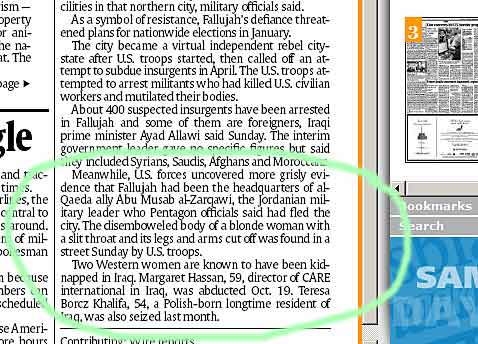
and then days of silence in the media when, having heard
there were two known western women hostages in Iraq, Margaret Hassan,
and
Teresa Borcz Khalifa, a Polish woman (who was
freed November 19th), I failed to find any mention of this murder.
Margaret Hassan was not blonde, so who is this woman? A week later I
have still found no reference to her death. And what does the level of
damage
she appears to have suffered tell us about the quicksands of despair
and hate that oppression
can generate?
155mm US Artillery firing on Falluja
155mm
is a little over 6 inches. The US forces were firing into Falluja
apparently from several miles out of town with this weapon. What
possible justification can there be for such indiscriminate
violence?
My concern at the repeated TV news footage of US
artillerymen firing several 155mm rounds a minute was echoed, it turns
out, by
BBC reporter
Paul
Reynolds, who also asked why:
I have questioned many times
senior officers here about the use of heavy weapons because they have
been using 155mm artillery in Falluja, they have been dropping 2,000
pound bombs. The bullets that they fire are high
velocity. The buildings are of poor construction here -
the bullets travel through the walls. And when they see what they
believe to be militants - and these marines are incredibly calm under
fire, they are almost unflinching - they do wait until they see a guy
with a gun but when they see that, they open up with everything they
have got and the question is, how much collateral damage is there going
to be?
Falluja casulties
Yes I know
these pictures from al Jazeera are hard to look at, both feature
children, but there are others
that are worse. And this last week images of the civilian casualties of
the assault on Falluja have been notable by their absence from the
newsmedia I see. Here is an
al
Jazeera report on civilian casulties early in the November
post-election assault on Falluja.
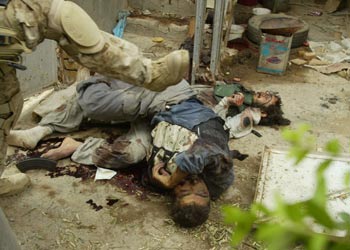
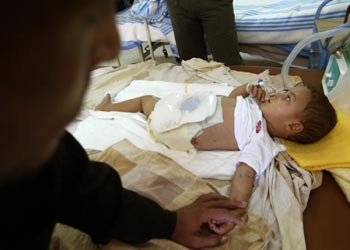
N.B. Despite American and Iraqi provisional government smears and
physical
attacks, Al Jazeera is an ex-BBC outfit that holds a very even-handed
Arab view of events in the Middle East.
US soldiers kill wounded men in
Falluja
The NBC video of US soldiers shooting a wounded rsistance
fighter in Falluja seems to have disappeared but these four frames
from
it...
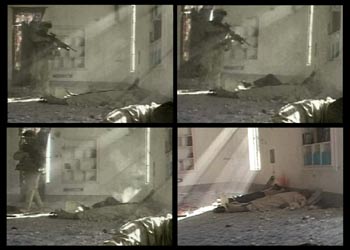
....convey the casual brutality of men so stressed out by training and
indocrination that they can see defenseless
wounded opponents as 'unmenschen', having 'lives
devoid of
value'... so that, as here inside a mosque, they can kill them.
Here from the blog of Kevin Sites, the freelance cameraman who filmed the shooting, is his
open letter to the marines involved.
Iraqi suicide bombers—who are they?
One of the features of the armed struggle going on in Iraq that seemed
to be entirely invisible to the media I read is the sheer numbers of
people who are prepared to kill themselves in opposing the US attack
and occupation. I haven't counted but it seems like more than one a
day, week in week out.
Is it possible that these men are remnants of
the Saddam Hussein regime? Why kill yourself to bring him back? If not,
how come these men have to wear the label 'insurgents', bought into by
all the media I read. Considering the numbers and frequency of suicide
bombing,
what a strange label, one that seeks to tell us that they are
'outsiders'—not indigenous people so infuriated by the violence of the
US attack and occupation that they are willing to kill themselves to
reverse it?
Perhaps, as other men have down the centuries, including the American
and British
troops occupying their country, they are dying for God and Country.
What else could this many men willing to kill themselves
mean?
As I have written elsewhere here, suicide bombing,
whether
at bus stops, in airliners, or cars, is a weapon that at a stroke
obsoletes the most fancy techno precision weapons of the alienated, if
courageous patriots, of the UK and US military.
Hunting
Yes, domination does sometimes seems to be an immovable a feature of
the
landscape and then, as with hunting, years of courageously indignant
people-pressure win through, and a corner of domination is rolled
back.
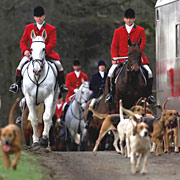
Amid bizarre scenes of procedural confusion, the UK Parliament voted
this week to stop the hunting of foxes for fun in the UK.
To appreciate fully why this is significant in the UK, you need to
understand that hunting is a remnant of feudal i.e. fullout baronial
domination, sustained by the rich and powerful in the UK for a thousand
years. The British royal family are blood
sports enthusiasts, and for social climbers and the landed gentry,
hunting has remained a jewel in the crown of the
seigneural/aristocratic tradition.
Hunting, with its ceremonial dress and the blooding of new recruits,
has always seemed to me an archetypal example of dominance in action.
The fight to keep hunting in the UK hides a covert agenda—"hands off
our
hereditary power and wealth".
The fightback, by the House of Lords, initially unsuccessful, will no
doubt be followed by other pressures from the feudal wing of the
Countryside Alliance. Labour's Baroness Mallalieu, who is also
Countryside Alliance president and who led opposition to the Bill to
ban hunting with hounds in the House
of Lords, said the Hunting Bill was "rank bad", adding: "Its
foundations
are naked prejudice and wilful ignorance, it is without rationality and
without principle". Comments that it struck me, apply only too well to
hunting itself.
Palestinian Child Deaths
Figures published 30th October
by
Al Jazeera appear to show that the Israeli
Defense Forces [IDF] are killing an outrageous number of Palestian
children.
In
October 2004, the number of children and minors under 17 killed by the
IDF has
climbed to 33. An Israeli officer, who in
October shot a 12-year-old Palestinian child
in Rafah in southern Gaza 20 times to ascertain that she was dead, was
arrested briefly but only on
suspicion that he lied about the incident.
Many, or most, Palestinian children killed have been on their way to
school or have been have been imprudently stoning the Caterpillar
Inc. bulldozers that demolish their homes.
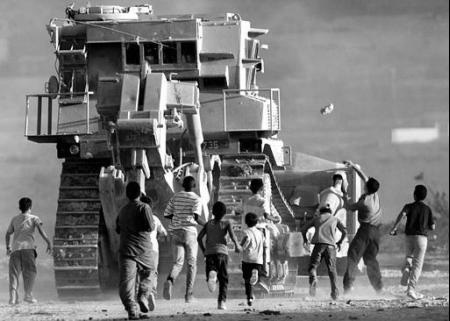
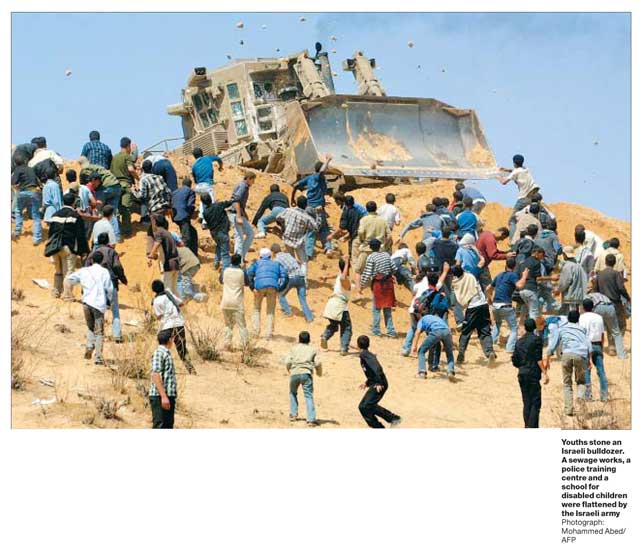
There are 0 writeback comments for this entry
posted at: 08:08 | permanent link to this entry
Fri, 05 Nov 2004
God invades White House
'... surveys have shown, that many more Americans
believe in the
Virgin Birth than in Darwin's theory of evolution.' The
Day the Enlightenment Went Out By GARRY WILLS nytimes.com/2004/11/04/
The 2004 US Presidential election has seemed to have obvious relevance
for
this
inquiry into love, and its antithesis, domination. I've already made
three tries to find
a voice that is up to the task of
writing about it. They all ran into the sand. Too
reasonable. Too even-handed for the amount of feeling that I and lots
of other people had running, both before and after the US election.
1. Satanic
Theology
For months past I've been digging into what various people have had to
say about fundamentalism,
an
article by Karen Armstrong, her book,
The Battle for God, and Almond,
Appleby and Sivana's summary volume,
Strong
Religion of a huge, 10-year, US funded, research study into
fundamentalism
world-wide, that
includes details of the origins of such groups across America.
Here are some headlines.
World-conqueror
In the
world-conqueror pattern we see the most
virulent type of
fundamentalist movement in terms of the disruption of a previous order.
....The world, a realm of Satan
and
darkness, must be overcome if not brought back into the fold. Its
institutions,
structures, and values must be brought under the control of the true
believers. Strong Religion p151
Rolling back Secular Humanism
[In the US] The
shift
to an
operative
postmillennialism—the
belief that Jesus would
come only after Bible-believing Christians had prepared the way by
inaugurating the era of righteousness on earth—was triggered by the
moral and
social crises of the 1960s. ... Bible-believers could no longer wait
passively for Jesus
but must protect the next generation of Christians by concerted
political efforts to "repeal" or "roll back" secular humanism...
...Falwell
and his associates in the Religious Roundtable
and other Christian Right lobbying groups pushed Protestant
fundamentalism toward a new, world-conquering pattern of political
activism in
reaction to the threatening pluralism of belief and lifestyle that
appeared to be
overtaking "Judeo-Christian" America. Strong
Religion p156
Theocratic politics
The first wave of
this new
political activism, designed to "take back"
the courts, schools, and Congress from the secular humanists (and,
presumably, to vanquish them or at least diminish their role in public
life),
was active during the Reagan presidency and followed a strategy of
applying
pressure at a national level. A second wave, inaugurated by the
Reverend Pat Robertson's Christian Coalition in the late 1980s and
1990s,
profited from the lessons of the Moral Majority era and focused its
impressive and far more successful political activism on local
politics—state
assemblies, school boards, state political parties. Strong
Religion p156
A bid for power
The growing conviction of Jerry
Falwell,
Pat Robertson, Randall Terry, and Tim LaHaye in the late seventies as
to the possible
emergence of a Moral Majority, likely to acquire hegemony in American
politics and
culture, made them introduce a "postmillennial window"' into their
premillennialism. They assumed that the arrival of the millennium
depended upon their activism. Tribulation would precede Rapture, not
follow it.
In consequence, one should act immediately in order to better American
society, otherwise devastation would be so comprehensive as to hit the
saved as well, and anyhow, it might be so cataclysmic as to render
reconstruction extremely difficult. Only a daring bid for power, until
then thought to
be an un-Christian course of action, could save the day. Strong
Religion p70
After sifting what felt like a small galaxy of stuff on fundamentalism represented
here by these quotes and my
earlier article, I
realized
why I, and a lot of other people, not least the liberal-leaning inhabitants
of
the US, were so wound up about the 2004
US Presidential election result. It seemed
to point to a threshold being crossed:
As Sister Joan Chittister OSB writing of the 2004 Presidential
election puts it.
I would call it a warning, a
signal of things to come, the
klaxon of what is clearly a crossover moment in time, perhaps, but not
a real profile of the historic American character and hopes....
...we did not, in this particular
political exercise, see the
fundamental ideals of the American public -- respect for differences,
separation of church and state, the common good, and justice for all --
in full sway. We did see ideology at its most punishing, smothering and
narrow worst.
...what we saw is what extremism
looks like, what cultural
evolution looks like, what fear looks like, what religion run amuck
looks like. We saw radical right fundamentalist religion pitted against
the most shameless definitions of secular liberalism as weak, immoral
and irresponsible. It was the battle of two one-eyed monsters writ
large. No nuances. No common ground. No common sense. No real
evidence.
Joan Chittister, OSB
God invades
White House
2. Enough of facts - my mind is made up
The 2004 US Presidential election result appeared to show that
since 9/11 a majority of the
American people have bought
into a patriotic loyalty oath promoted by the US administration. One
that entails believing in a '"war"
on
terrorism'; Iraqi possession of 'weapons of mass destruction';
Iraq as a complicit in the 9/11
attacks; and calling the attack on Iraq a "war". Aren't these fictions?
Aren't they blatant pieces of trance
induction intended to consolidate the power of the Bush administration
through further terrifying the
American
population and marginalizing and denying
dissent?
The Power of Nightmares,
the BBC2 series by Adam Curtis, (
video
Part 1, Part 2,
Part 3)
offered
almost three hours of
video evidence that this was a plausible explanation. If so, how come
so many
people signed up to
this apparent failure of common-sense?
And then I remembered that the fundamentalism studies had shown that many millions of committed
church-goers in the US, perhaps 30% of the population, live within the
'enclaves' of a variety of forms of christian
fundamentalism. Through owning and controlling churches, schools, home
schooling, colleges, publishing, broadcasting, and in
some areas, even shopping, the enclaves seek
to be self sufficient. What I hadn't appreciated was that such enclaves
are a way of ensuring
that people of faith are actively
out of touch with other ways of being in the world. The
enclave is a vessel of faith, of righteousness, and the
god-less outside world is perceived as 'bad', even 'evil', to be
avoided. Political
choices within this cultural deafness filter down through charismatic,
male,
authoritarian,
local or national religious leaders, and are re-enforced by a vast
christian media
network.
Ostensibly such enclaves,
a key element of
fundamentalism everywhere, are defending themselves from
the moral
decay
of pornography, sexual freedom, political correctness, gay
rights,
feminism and the free-wheeling liberal critiques of secular
institutions such as governments, universities, science and
publishing. A closer look suggests that christian resistance to being
over-run by liberal values has
less to do with a perception of moral disintegration, and much more to
do with holding on tight to
a short list of the
specific moral values that they have selected from the Christian story
book;
especially patriarchal
male
dominance, the
subordination
of women
and the un-naturalness of homosexuality, and alongside these, the idea
that the nature is a resource to be exploited.
The 2004 US Presidential election appears to have been won as this BBC
report confirms, on the basis
of
large
numbers of christian conservative voters seeing George W. Bush as
embodying these selected
'moral values'.
God invades
White House
3. Unpicking the power of
righteousness
In the task of understanding the 2004 US presidential election
result, research into the moral values of
christian fundamentalism has been vital. What
feeds and sustains such values? Yet another strand of American
research, this time by cognitive
scientist and linguist George Lakoff, shows
how
notions such
as 'moral values' are human
constructions, rooted in the human capacity for metaphor:
Moral order is based on a folk
theory of the natural order: The
natural order is the order of dominance that occurs in the world...
God is naturally more powerful than people
People are naturally more powerful than animals, plants and
natural
objects
Adults are naturally more powerful than children
Men are naturally more powerful than women. Lakoff Moral Politics p81
The consequences of the metaphor
of moral order are enormous,
even outside religion. It legitimates a certain class of existing power
relations as being natural and therefore moral, and thus makes social
movements like feminism appear unnatural and therefor counter to the
moral order.It legitimates certain views of nature, e. g., nature as a
resource for human use, man as steward over nature. Accordingly it
delegitimizes other views of nature, e.g., those in which nature has
inherent value. Lakoff Moral Politics p82
In addition [the
metaphor of moral order]
focuses attention on questions of natural superiority...
there are people (typically wealthy people) who believe that the rich
are morally superior to the poor. Indeed that belief is explicit in
forms of Calvinism, where worldly goods are a reflection of
righteousness. Lakoff Moral
Politics p83
Might
the
heightened awareness and level of feeling that many people have about
the
2004 US
Presidential election amount to some intuition that
we are living through
a critical point in history. One where the "morally superior" rich of
America, led by a
charismatic (and Calvinist) leader, license themselves to further
institutionalize a belief in the equivalence of righteousness
and wealth? Have we reached a
threshold where
we
realize, to our horror, that the Bush administration is leaving behind
secular,
liberal plurality; leaving behind justice,
negotiation, and the rule of law;
and is intent on installing a 'Kingdom
of the God-fearing'?
I'm reminded of a New Yorker
cartoon where, as Adam and Eve
disport themselves in the Garden of Eden, the hand of God, waving a
warning finger, reaches out from the heavens, and a voice declaims,
"Rule No:1
don't piss me off". This seems to epitomize
the Bush administration style. Well hidden
behind often Orwellian language (The "Clear
Skies Act 2003" licenses industry to pollute - The"Healthy Forests
Initiative"
licences the damaging clear-cutting of forests) are the
god-given absolutes of biblical
inerrancy. These highly selective fear-laden fragments of the Christian
story cascade down through layer on layer of authoritarian,
patriarchal, (and usually male) leaders, to
terrify other,
subordinate creatures, and
thus much of the rest of the
world, into compliance with American interests.
God
invades White House
4. Holding the Big
Picture
Was the distress many of us felt
about the Bush re-election due to it seeming to threaten the
negation of so many of the socially vital gains of recent decades?
Or as I fancy, is it more a matter of two
steps forward, one step back?
Am I taking refuge here in
ungrounded optimism, some resuscitation of the much derided
notion of 'progress'? Perhaps, but I am old enough to have seen a
major
over-arching development in recent decades—the
evolution in attitudes to childcare. Childcare has moved away
from the fear-filled
alienation of authoritarian control—toward nurturance and
gentleness—meeting the child's needs rather than controlling their
behavior, (the UK, trailing other
European nations, is even legislating to criminalize
smacking children).
Along side this in the last 30 years I have seen the
gradual emergence into
public consciousness of child abuse,
neglect,
bullying, paedophilia,
and
domestic
violence.
All of which
amounts to a raising of consciousness about
domination, albeit haphazard and fragmentary, and often highly
contested. But I have the sense, looking at the 'big picture', that
history is inexorably moving in this direction,
If you are skeptical, I recommend Lloyd de Mause's History
of
Childhood, which shows extremely convincingly the
historical
trajectory from astonishingly abusive
parenting, toward more
caring, more loving, more child-centered approaches to upbringing and
child-care. With, as a likely consequence, the moderation and/or
marginalizing of
domination. Locally it can be hard to see but
generationally it seems to be a notion that has legs.
God invades
White House
5. The politics of
identity demolition
De Mause's psychohistorical approach
has been complemented
by George Lakoff's notion of two divergent parenting styles that he
details in Moral Politics,
see this article for
a brief account. He calls
them 'Strict Father' parenting and 'Nurturant' parenting, and
he equates these with a
conservative and liberal politics that correspond to each parenting
style.
Christian
and islamic
fundamentalism both appear to to
enthusiastically
endorse 'Strict Father' parenting i.e. patriarchy.
Here
are a couple of
items from a modern (1972) christian child-rearing manual:
The spanking should be
administered firmly. It should be painful and it should last
until the child's will is broken. It should last until the child is
crying, not tears of anger, but tears of a broken will. As long as he
is stiff, grits his teeth, holds on to his own will, the spanking
should continue. (Hyles, How to rear
Children pp99-100 in Lakoff: Moral
politics)
Obedience is the most necessary
ingredient to be required from the
child. This is especially true for a girl, for she must be obedient all
her life. The boy who is obedient to his mother and father will some
day become the head of the home; not so for the girl. Whereas the boy
is being trained to be a leader, the girl is being trained to be a
follower. Hence, obedience is far more important to her, for she must
some day transfer it from her parents to her husband. . . .
This means that she should never
be allowed to argue at all. She should
become submissive and obedient. She must obey immediately, without
question, and without argument. The parents who require this have done
a big favor for their future son-in-law. (Hyles, How to rear Children p158
in Lakoff: Moral politics)
Such 'Strict Father' parenting naturalizes domination and
subordination,
and as Lakoff shows in this
article, it shapes conservative
political beliefs in the US.
My guess is that part of the considerable distress and alarm that
many people such as myself have felt around the re-election of
President Bush, is
that it signals a move toward the
consolidation, and even extension, of the
'shock and awe' of America's 'full
spectrum dominance', at home and abroad, 'strict father' politics.
However, as the 'strict father' approach to childcare gives way to a
more 'nurturant' approach, many people sense
intuitively that
the expressions of ('strict father') 'family and moral values' that
shape the Bush Presidency are
facing
backwards in history.
They are in regression from a secular plurality
where, unencumbered by patriarchal theology, a rich variety of social
movements such as feminism, minority rights, gay rights, abortion
rights,
racial justice, innovative spiritualities, and ecological
awareness, have gained legislative and popular recognition. What these
movements have in common is that they roll back the 'folk theory' of
the naturalness of domination, especially male domination, perhaps
most effectively and essentially, in child-care.
And on the other side of the coin, exactly
these developments appear to be
anathema to fundamentalist christian church-goers.
Fundamentalist enclaves see these secular expressions of 'modernity',
or
as I would fancy 'post-modernity', as a revolt against God. And if you
are a person of faith, who "bears witness", "walks with the Lord", "is
busy harvesting souls", or "excising the cancer of deviation,
sexual
or otherwise", a revolt against God is the ultimate challenge. Why?
Because it threatens identity demolition. Faith, like the optimism in
this text, is an investment in a big idea, a "Yes". If
significant doubt arises,
such a 'Yes', can
morph into a "No".
If your whole identity is invested in the "Yes" of christian
or other fundamentalism,
based on the
inerrancy of biblical texts, then
de-construction or
questioning of this faith has to be strenuously resisted. After
all, none us want to 'go out of our minds'.
God invades
White House
6. Echoes and
resonances
For US christian conservatives, the secular values of plurality,
diversity, negotiation and power-sharing do realistically threaten
identity demolition.
American christian enclaves have reacted to these
perceived
challenges
to their faith with
the classic characteristics of fundamentalism world-wide. They have selected scriptural items that
support the present controversies while neglecting others, adopted moral manicheanism, signed up to absolutism and inerrancy, and framed the struggle
as
millennialism, the end of
history.
Selectivity
Protestant
fundamentalists of the United States select the
apocalyptic prophesies to be found in the books of Daniel and
Revelation... p94
...fundamentalism selects some aspects
of modernity to
affirm and embrace. Much of modern science may be accepted, for
example, and modern technology such as radio, television, VCR's
audiocassette tapes, telephone banks, and modern mailing techniques are
effectively employed. p95
...fundamentalisms select
certain consequence or processes of modernity and single these out for
special attention, usually in the form of focused opposition...
abortion in demand in the United States. p95
Moral Manicheanism
A
dualistic or Manichean worldview is one in which reality is
considered to be uncompromisingly divided into light, which is
identified with the world of the spirit and of the good, and darkness,
which is identified
with matter and evil. Ultimately, light will triumph over darkness. For
fundamentalist movements, as we have noted, the world outside is
contaminated, sinful,
doomed; the world inside is a
pure and redeemed "remnant." p95
Absolutism and Inerrancy
Fundamentalists...
share a recognizable approach to
religious sources. First, they steadfastly oppose... ...the
canons
of critical rationality as defined by outsiders. Instead of following
philological
or historical methods, fundamentalists employ their own distinctive
strategies of interpretation, including "hardened" and "updated"
traditional
approaches, designed in part to reify and preserve the absolutist
character of the
sacred text or tradition. p96
Millennialism and Messianism
History
has a miraculous culmination. The good will triumph over
evil, immortality over mortality; the reign of eternal justice will
terminate
history. The end of days, preceded by trials and tribulations, will be
ushered
in by the Messiah, the saviour.
Do you find echoes and resonances between the
2004 US presidential election and these
headlines from the
ten year study of fundamentalism
around the world
into
christian fundamentalism? Here are some further
quotes
from that study
that may account for the sense of urgency that has energized the
christian right
in recent years.
American
fundamentalists see the United States as the third
concentric circle of their "moral landscape," beyond their own
independent church and the loose network of churches to which they
belong (Baptist Convention, Liberty University graduates, etc.).
America is of course endowed
with a theological dimension (as the City on the Hill),... ...The fourth
concentric circle is the Middle East, with the Holy Land as
its hub and the war theater of the Apocalypse. The prophetic landscape
depicted
in the Books of Ezekiel, Daniel, and Revelation saw its veracity
confirmed
by the strategic role of the Middle East in the international arena
over
the last quarter century. Cosmology has suddenly been endowed with a
down-to-earth significance. (106) Strong
Religion P73
Often, as noted above, the
movement
really gets off the ground only when a cataclysmic, transformative
event
occurs either within the movement itself or, more likely, in the local,
national, or international environment external to the movement. The
trigger creates
a new set of circumstances that provides an opening for a
fundamentalist movement to expand and assert itself under the guidance
of a
charismatic authoritarian leader." Strong Religion p135
God invades
White House
7.
Death of the American dream of
invulnerability
Initially
I bought into the trance induction
of accepting the appalling 9/11
damage as an unprovoked attack on the US by Islamic
terrorists.
That was how it looked. And
then, as
day by day the media built up the posture, constantly reinforced by the
Bush administration,
that the
US was an entirely innocent victim,
the
trance bubble popped. as
though US complicity with oppressive authoritarian regimes in
Egypt, Iraq, Saudi Arabia, Iran and Israelestine were not part of the
historical record. A
huge store of goodwill was
sacrificed.
Then followed the acting out of revenge on
Afghanistan, one of the poorest countries on earth—and so recently an
ally against a previous 'evil empire'—the
USSR (check
out Stallone's Rambo 3 for
details) and not long after, the illegal attack on Iraq. In a massive betrayal of trust,
the
Bush US administration followed, and
later (Iraq) exploited, a political need to rationalize
the newly exposed vulnerability of the US and justify vengeance. Rarely
in
history can 'persecutor' have reversed into 'victim' and back to
persecutor so quickly,
From the perspective of several years on, 9/11 looks like an incident
in
a war of attrition between fundamentalist ideologies, christian and
islamic, that has been going on since at
least the
Iranian hostage
crisis and Beirut bombings. The two ideologies seem to have much in
common, not least profoundly
misconstruing each other. Islamists see the US as the epitome of a
satanic modernity that is a threat to the Koran based culture.
Since
9/11, the
US
has behaved as though the
modern
methods of fundamentalist islamists such as Osama bin Laden and al
Queda posed a
critical challenge to the US world hegemony. As though the overwhelming
asymmetry of
wealth and resources didn't exist.
I have to keep reminding myself
that fundamentalism is archaic only in it's beliefs, in its
methods it is typically highly innovative and indeed persons willing to
kill themselves, and thus make routine objects such as home videos, cars and planes
into very lethal weapons, are very modern form of weaponry.
So, following 9/11, in the US and al Queda, we
appear to have two opposed fundamentalisms each out to undermine or
destroy the 'modernity' of the other.
However if we pop the trance bubble of feeling equally terrified of
both of
them, what we see is a gigantic
asymmetry, the stupendous technological power and might of the world's
only
superpower
severely challenged by the strikingly modern innovations of al
Queda's networked autonomous cells and
suicide bombers. But, as I have learned to appreciate,
(see BBC2 The Power
of Nightmares
video
Part 1, Part 2,
Part 3)
while
undoubtedly
posing some risk,
the
fear of an Al Queda attack has been hugely
inflated
for
political reasons
by
the US and British administrations.
It is not difficult to see how the US would
see such critical innovations
as suicide bombers as doubly threatening, because
ultimately
there is no secure
defense
against them, thus key aspects of US
technological
might
are
rendered obsolete
overnight. And of course it is not only the opposed
forces that are asymmetrical, the level of damage, however painful to
us,
in New York, Madrid, Bali and Morocco, is as nothing caused by the
generational damage wreaked by the US,
think Philippines, Vietnam, South America, Palestine, Iran, or Saudi
Arabia.
And yet, was there not always the option, as the UK (IRA) and Spain
(ETA) have
seen,
of refusing to buy into the fundamentalist (terrorizing) trance of
9/11? Of
seeing these as damaging
actions of dissidents, a (major) nuisance, but part of the price of
democracy; of choosing to respond by asking, 'Why us?'. 'Why now?'. Why
couldn't the US administration do this?
God invades
White House
8. Rolling Back
Modernity
For US
christian
conservatism, 9/11 provided both a
confirmation of its apocalyptic visions
and a priceless window of opportunity. Both of these fed the
unprecedented vigor of the
2004 presidential election campaigns in which—as
Esther Kaplan details in With
God on
Their Side— through
America's
born again, Calvinist leader,
George W. Bush,
christian
fundamentalism continued
its invasion of the agenda of the US administration. Their
intention, as I hope may already be clear—rolling back
modernity; at home, liberal modernity, abroad, islamic modernity.
Putting god in the White House.
So what is this liberal modernity that the US christian enclave
(strictly
speaking this
should be plural) feels so threatened by? A
rich variety of legal assertions of human rights and the
criminalizing of sexual and racial
discrimination—not to mention
animal
rights—that have made their way on to the statute books.
Liberal modernity
favours tolerance,
mutual support, cooperation, the right to
dispose of our bodies, especially if we are women; to share power, to
negotiate, to live within the law, to honor the public and the private
universes, to help the needy, to honor dissent? A list that even Jesus
might endorse, were He around to be asked.
Darwin and DNA
The pre-modern narratives of
christian enclaves have no place for the sheer plurality of
modernity—astrophysics, molecular biology,
sociology, psychology, evolution
and stem cell research. But as it seems to me,
what will ultimately consign christian fundamentalism to the history
books lies in
the spiritual, political and psychological de-construction of
our folk theories of reality—the post-modern universe—that shows the
extent to which all such stories are humanly constructed. And parallel
with this—the generation
of new spiritualities that are outside patriarchy, that favor
authenticity and open-ness and that honor the sacredness, the
intrinsic value, of
all life.
Perhaps ultimately what traumatizes, and thus petrifies the
fundamentalist imagination, is an awareness that, running through all
these lines of post-modernity is a core human discovery, transparent
and dramatically fruitful in physics for decades; that what we see, and
the knowledge we generate, is shaped by who is
looking. And the more intensively we
look into nature, the more there is to find, and the more what we find
echoes who
we are. A paradox from which there
is
no escape, nor is there need for one.
And just as threatening to the fundamentalist christian sensibility,
post modernity tell us about process,
reflexivity, emotionality, nurturance, metaphor, transference and so on.
Above all it tells us
about power,
its nuances and its ubiquity. It shows us that just as there is no
escape from our personal constructions of reality, so there is no space
that is free from power relations. And as power thus deconstructed
comes out in into the light of day, the inequities and injustices of
its
distribution in the world come into sharp focus. And nowhere is
power thus rendered transparent, more visible, than in relations
between parents and between them and their children. And so we arrive
again at the feminist critique of patriarchy, of male dominance. In the
new
narratives of sexuality,
intimacy and power, to quote the title of
recent book, power is not
biologically determined but is a matter of
negotiation.
And this I believe, is ultimately what is indigestible for the
christian and conservative right in the US. Understandably, because for
many believers, many people of faith, to acknowledge, let alone
embrace, the discoveries of
post-modernity would, as I have mentioned earlier, be tantamount to
identity demolition.
The 2004 Presidential
election generated a lot
of heat,
not only in the US. This I feel was due to the correct perception that
it involved a sharp confrontation between such divergent approaches to
power. For
the moment,
in
electing George W. Bush,
the conservative christian right,
have succeeded in forging a shield against the intrusions of modernity
that they feel so much pollute and demean the purity of the Christian
message. They succeeded in overwhelming the constituencies of people
who value a
post-modern approach to spirituality, one that supposes multiple
stories
rather than the single Big Idea of the Christian narrative.
However, the jury is out on whether they have defeated the post-modern
narratives of plurality and power-sharing, or whether the Bush
Presidency will prove to be a nightmare from which the world will one
day awaken, a
dream that will
eventually implode, more than likely economically, or due to the
wounds from a
deepening, self-created, Middle Eastern crisis—as the Bush
administration
continues to
insist on crashing
America into
the world.
Lastly and not least, there is a sense in which the US polity behaves
as if the whole of psychology did not exist. As though for 100 years,
and
especially the last 50 years, not least in the US, there has been a
wonderful flourishing of psychological knowledge about group,
inter-personal intra-psychic and social relations.
And
I guess... psychology
is one the core sticking points for the vast
majority of the christian right,
since it is built around the notion
of 'process', of 'reflexivity', of becoming aware of how we do what we
do, of the context
and antecedents of our actions, of becoming competent emotionally,
of
being able to investigate and integrate the shadowy reaches of our
identity and re-evaluate, re-create, and
regenerate, aspects of
ourselves that are over- or under-endowed. So far as we
become even a little bit aware of 'process', we will be likely to to
notice when someone is attempting to entrance us. We'll be better able to
see through and out the other side of a religiosity that
functions as a kind of exclusive (and excluding) loyalty oath, that
disallows
choice and dissent, and, through denying the
Christian message of love and tolerance,
legitimates violence.
God invades White House
9. Postscript
This attempt to compost the
distress deriving from the 2004 US
Presidential election and the culture of domination that sustains it,
has lifted some of the bad emotional weather it generated. But I am
left
with a
troubling outcome to this line of inquiry.
Because they are often structured round a few
unifying, faith-based Big Ideas—
patriarchy,
or male
dominance—christian
conservative
groups seem more able than liberals
to agree on campaign strategies that favour a
narrow range of issues with which large populations can identify. Media
coverage that repeats such notions ad
infinitum through
interviews, photo-opportunities and commercials, amounts
to trance induction, and such spellbinding promises of 'security'
in the face of the inflated threats of a
'war on terror', can come to dominate political
discourse, as they did in the 2004 Presidential election.
If,
by
contrast, you favor a paradigm of human
relations that values diversity, plurality, nurturance, equality and
empathy, these generate multiple messages, multiple meanings, multiple
aims, that can seem incoherent en masse (though not necessarily
locally).
Politically this seems to me very problematic. How do liberal ideas hold their place in the world without compromising their
diversity?
So a key ongoing element of this inquiry into domination is how to
resolve this
dilemma. How can we create institutions, descriptions, naming,
metaphors, and symbols, that hold true to notions
of
plurality, authenticity, nurturance, empathy, caring and love? So that they hold their value in contests where a handful of big ideas shaped by covert notions of absolute truth are used to sustain and regenerate control and dominance.
There are 0 writeback comments for this entry
posted at: 07:59 | permanent link to this entry
Thu, 21 Oct 2004
Walls
One of the most shocking moments of my life was to visit Berlin in the
60's and stand looking over the Wall. I was impressed less by the wall
itself
than the wide swathes of bare earth, the electrified fencing, barbed
wire and the armed border guards in their towers.
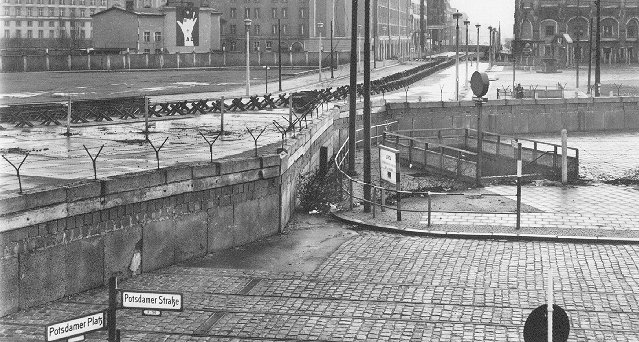
My feelings of shock, I now suppose, were due to the confrontation with
raw power, state power, domination—in one of the forms I am coming to
recognise through this enquiry—the extreme vulnerability of East
Germany dressed up in
invincible, impenetrable, Stalinist armour.
Why this memory? Why now?
Floating out of the churning hurt of
this morning's news
and
trying find my place in it. Again.
Came images of other walls, other fences, other locked gates. Other
armouring.
Out of order. Mixed up.
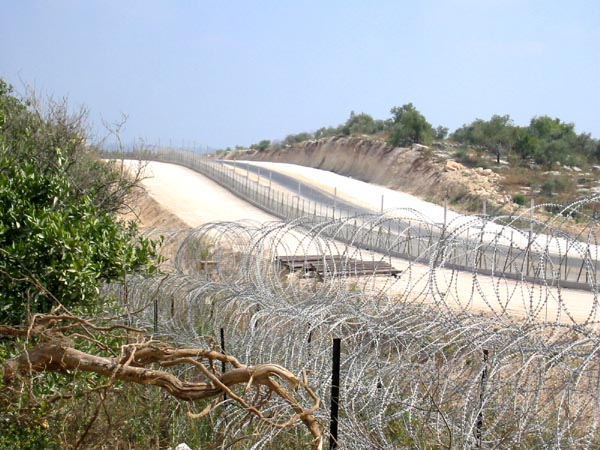
A
completed section of the [Israeli 'separation] barrier’s' first phase,
near the town of Qaffin
(pop. 8,200), July 2003. Although the barrier’s exact elements differ
according to location and topography, its core is an electrified fence,
10 feet high, equipped with surveillance cameras and other sensors. It
is flanked on either side by six-foot-tall barbed-wire pyramids. Other
obstacles include a trench six to eight feet in depth, a military
patrol road, and a dirt path to record footprints. The barrier’s total
width ranges from 60 to 100 yards.
© 2003 Miranda Sissons/Human
Rights Watch
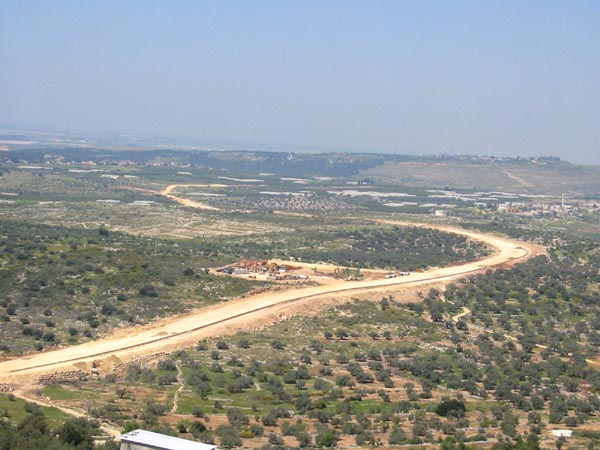
View of
the barrier’s path from Jayyus (pop. 3,078), in Qalqilya governorate,
April 2003. According to the U.N, residents of Jayyus have been
separated from four water wells and two-thirds of its total land area
by the barrier, harming agriculture, incomes, and livelihoods.
Residents in at least 35 other communities have been separated from
their land by the barrier’s first phase.
© 2003 Miranda Sissons/
Human
Rights Watch

Here in Northumberland around 1800 years ago, the Romans, finding
themselves vulnerable to
incursions by the barbarian Scots, also armoured themselves. They built
the 73
miles of Hadrian's Wall. View of the wall, looking east towards
Housteads Camp © Denis Postle WLR

A section of the Israeli "Separation Barrier" at Qalqiliya under construction.

Israeli "Separation Barrier" guard post and watchtower near Qalqiliya.
1.3 million refugees live in Gaza one of the most densely populated
areas of the world. 8000 Israeli "settlers" occupy a third of the land,
control access to much of the water and enjoy a network of roads built
and maintained exclusively for their own
use. Palestian refugees face increasingly severe and often arbitary
restrictions on even local travel.
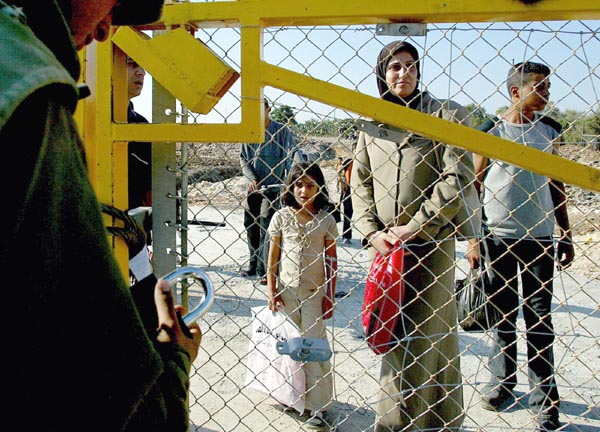
An Israeli
soldier locks one of the gates in the separation barrier near the town
of Qalqilya, July 2003. The city of Qalqilya and surrounding villages
and towns have been particularly hard hit by the barrier, affecting
some 45,000 residents.
© 2003 Agence France Presse, Text:
Human Rights Watch
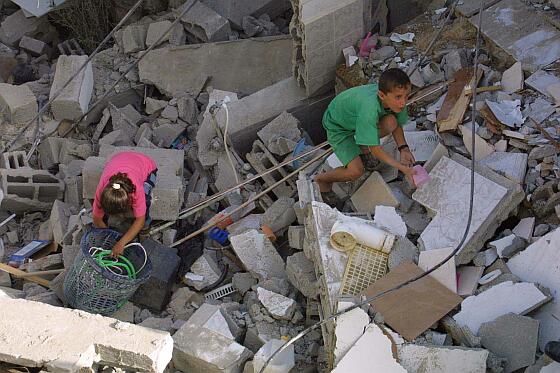 click on the picture for the BBC's picture allery of the
aftermath of the Israeli attack on Rafah.
click on the picture for the BBC's picture allery of the
aftermath of the Israeli attack on Rafah.
Building the "separation barrier" and establishing a no-go zone 300
meters on either side of it has entailed countless gross violations of
Palestinian human rights.
As the
Human Rights
Watch
report "Razing Rafah" that has preoccupied and distressed me today
details, the Israeli administration's mix of punishment, revenge and
reprisal as they created and extended a buffer zone around Rafah meant
over the past four years that 10% of the population, 16,000 people,
lost their homes, being reduced to picking over the rubble of their
homes for traces of their possessions, and for many, living in tents.
Along with vast swathes of gratuitous damage to orchards, greenhouses,
a zoo, and other infrastructure, the armada of American equipped Apache
helicopters, tanks, F16 fighter bombers and armoured D9 Caterpillar
bulldozers, wrecked 298 house in May alone.
According to the Palestinian Central Bureau of
Statistics, 393 residents of the Rafah governorate were killed between
September 29, 2000, and August 31, 2004, including ninety-eight
children under age
eighteen ...
In the same period, Palestinian
armed groups killed ten Israeli soldiers in Rafah. One was killed
while
patrolling the border, in February 2001; four others were killed during
incursions inside the camp. The other five soldiers were killed
on May
12, 2004, when Islamic Jihad fighters destroyed an Israeli armored
vehicle with a
rocket-propelled grenade.
The IDF invoked this latter incident to justify the further expansion
of the
buffer zone through wholesale demolition of homes.
Human Rights Watch
A Distant Mirror?
Faced yet again with the grotesquely disproportionate violence visited
on the Palestians by
the Israeli administration... I wondered again... where had I
previously felt upset in the way I have today?
And I remembered.
In the early 80's while researching
a film about human nature, I visited KD Dachau outside Munich. Even
though it is now mostly an empty space,
it brimmed over with echoes of the pain, hurt, damage, and death
visited on the people unlucky enough to be incarcerated and tormented
there.
"Work makes freedom" reads the sign on the gate which welcomed people
to
Dachau. Industrial strength cynicism. In the museum, what brought tears
was a picture of a woman with a young child also on the wrong side of a
fence,
unmenschen, people
deemed to have lives devoid of value.
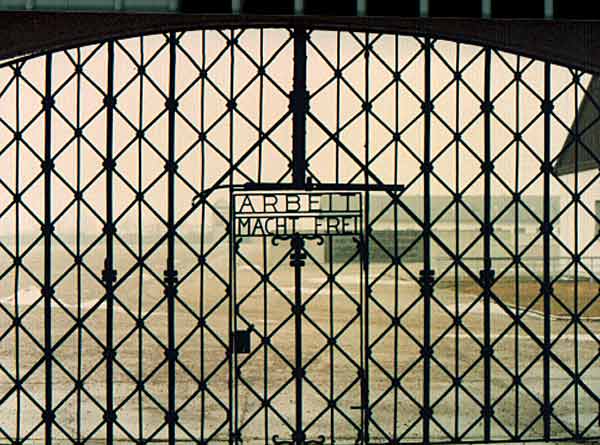
The following day I travelled to KD Mauthausen, one of two dozen
concentration and slave labour camps near Lintz in Austria. What had
began as a film location search became a pilgrimage, as inadvertently,
I arrived
in Linz in the middle of the night. As I sat with others in the station
waiting for morning, armed policemen prevented any of us from
sleeping. No sympathy for weary vulnerability there.
I found KD Mauthausen profoundly moving. Unlike Dachau, so much of it
was still there
that less was left to the imagination. In a
touching re-occupation, as though by the souls of the dead, large parts
of the
camp are encrusted with ceramic images of the mainly Italian but also
Dutch
and Russian people who were killed there. For a sharp lesson in the
what cultures of domination can mean I recommend a visit. Don't miss
the
nearby Schloss, a medieval castle, where the Austrians collected and
gassed all the disabled and 'mentally retarded' children of the Lintz
neighbourhood.
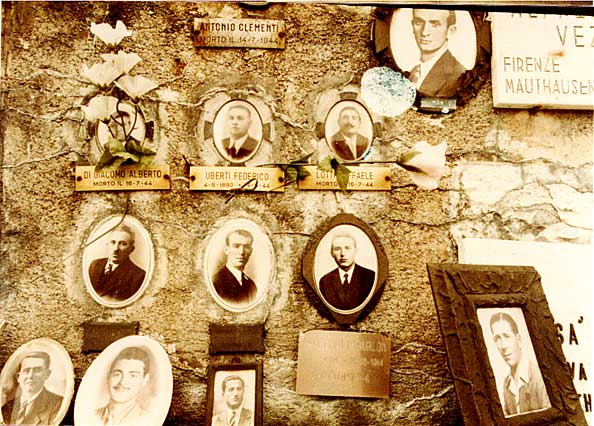
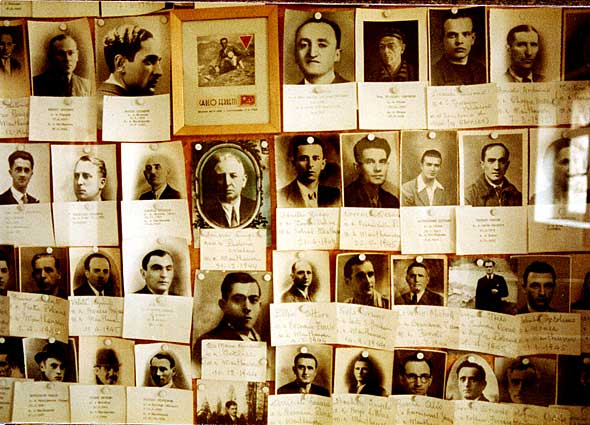 ApartHate
It may seem too big a jump and I am open to being contradicated, but as
I try to look at the big picture, what Israel seems to be doing, albeit
I believe unconsciously, with the separation barrier and its
astonishingly excessive use of force, coupled with abuse of power at check points, etc., in a bizarre inversion of Jewish history... is to turn Gaza into a concentration camp.
Despite its theological claims, even a brief look at its history shows
Israel to be an ill-founded colonial creation, still the occupier of
land stolen from the Palestinian people, who continue to object to this
theft and who seek justice and restitution. Feeling vulnerable
but in deep denial of the origins of their vulnerability, many, but not
all, Israelis, institutionalize their vulnerability, moving it from
being acute to chronic. And in pursuit of a some dream of military
invulnerability, armour themselves so effectively that they can crush
generation after generation of Palestinians while failing to feel for
their
hurt or their sorrow or their distress. This Israeli denial morphs,
rebounding as hate-driven Palestinian martyrdom.
The Israeli administration's response? Apartheit.
How can it be that we tolerate this of Israel? That for so long, and I
include myself, so many people bystand it?
The Spell of Security
For some years, even though I have been burgled and mugged, I have been
very sceptical of the preoccupation in the UK with what I think of as
'security as a form of unconscious impoverishment'. We apparently have
many more security cameras than any other country.
Here below, not far from where I live in London is another armoured
settlement. Is it a prison? A nuclear weapons research
establishment? Or a secure hospital for the mentally challenged? Or a
hugely expensive riverside housing? Guess... Seemingly at war with its
surroundings, it is a 'gated' housing development, one of perhaps
hundreds, even thousands, in the UK.

Could it be that our tolerance and bystanding (no economic boycott, no
trade sanctions) of the Israeli's denial
of vulnerability and culpability and their bizarrely excessive
armouring that so damages the Palestinians... arises because the
cultures of domination (and
exclusion) we inhabit have a lot of it in-house?

So far as we entranced by the belief that we need impregnable,
invulnerable, armouring as a way of being in the world (the gate in
this West London housing development even has a guard post) might we
not be replicating in ourselves the denial and armouring (and
psychological ignorance) that feeds and sustains the
Israeli/Palestinian conflict and the supposed clash of cultures
between Islam and the West?
Might this be why bystanding, passive acceptance of the intolerable, is
so common?
Footnote
Feeling something of the pain of a far distant people is no guarantee
of the accuracy of how we respond to it.
In honour of the complexity of the struggles between
vulnerability and armoured denial, and modernity and pre-modern
fundamentalism, I include this link (double-click the image) to a
story about another Wall.
 Police try to prevent a woman
from
disturbing Women of the Wall, right,
Police try to prevent a woman
from
disturbing Women of the Wall, right,
while they pray at the Western
Wall in Jerusalem, Oct. 15.
For almost 15 years, Women of the Wall — a prayer group that
includes women from all streams of Judaism — has been struggling to
break the Orthodox hegemony at Judaism’s holiest site, fighting for
both legal and social acceptance, hoping to be able to read from the
Torah, wear tallitot and pray out loud next to the venerable retaining
wall of the Holy Temple.
Their presence challenges an Orthodox tradition that only men are
allowed to take part in these practices... click on the picture to read
more.